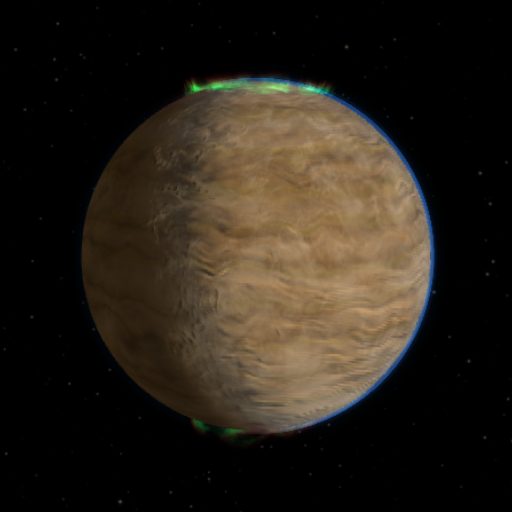
KOI-351 f, also known as Kepler-90 f, is the outermost of the small planets around Kepler-90, a Sun-like star about 2,800 light-years away with eight known planets, as many as our solar system. It crosses in front of its star every 125 days, and the NASA Exoplanet Archive lists its radius as about 2.9 times Earth's, which suggests a mini-Neptune rather than a rocky super-Earth.
It was one of four planets announced around the star in 2013 by a team led by Juan Cabrera, using data from NASA's Kepler space telescope, which watched for the small dips in starlight as planets crossed the star. Cabrera's team found that Kepler-90 f closes a chain of three planets, with d and e, whose orbital periods sit close to a 2 to 3 to 4 ratio. In such a chain the planets tug on each other at regular intervals. Beyond f lie the system's two giants, Kepler-90 g and h.
That layout, small planets inside and giants outside, is what led Cabrera's team to call Kepler-90 a compact analogue of the solar system. It is far more crowded: all eight planets orbit within about the distance of Earth from the Sun, and Kepler-90 f, at about half that distance, receives nearly seven times the light Earth gets. Its mass has not been measured; the archive's figure of about 8.7 Earth masses is an estimate from its size. An independent 2013 analysis by the Planet Hunters citizen-science project found the system's planets stable over long periods.