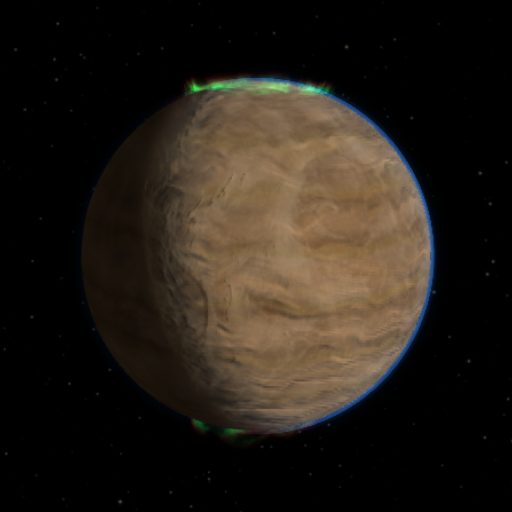
KOI-351 h, also known as Kepler-90 h, is the outermost and largest known planet of Kepler-90, a Sun-like star about 2,800 light-years away with eight planets, as many as our solar system. It is a gas giant about 11 times Earth's width, a little larger than Jupiter, and it orbits every 332 days at about the same distance from its star as Earth is from the Sun.
It was one of three planets around the star listed in the Kepler mission's catalogue before 2013, when a team led by Juan Cabrera validated it and four new planets. Its mass comes from its gravitational tug on its neighbour Kepler-90 g, which makes both planets' transits arrive hours early or late. In 2020 a team led by Yan Liang used those timing shifts to estimate Kepler-90 h's mass at about 203 Earth masses, roughly two-thirds of Jupiter's. In 2025 a team led by D. E. Shaw added a decade of measurements of the star's wobble and a transit of g observed from the ground in 2024, and confirmed that mass.
Kepler-90 h receives a little under twice the light Earth gets from the Sun, according to the NASA Exoplanet Archive, and has an estimated equilibrium temperature of about 290 kelvin, close to Earth's. As a gas giant it has no surface, so the habitable zone, the range of distances where liquid water could last on a surface, does not apply to it directly. Kepler saw it cross its star only three times. Cabrera's team noted that, unlike Jupiter and Saturn, the larger giant here is the outer one, an arrangement closer to what models of planet formation expect.