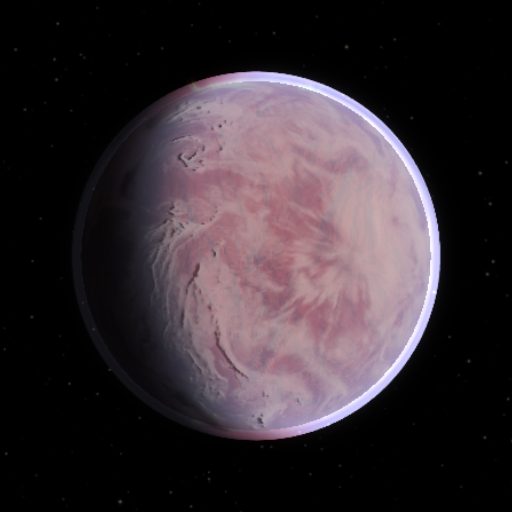
L 98-59 c is a rocky planet about a third larger than Earth whose atmosphere has been searched for with both Hubble and Webb. It orbits L 98-59, a bright red dwarf about 35 light-years away, every 3.69 days. NASA's TESS satellite found it in 2019 together with L 98-59 b and d, by catching the small dips in the star's light as each planet crossed in front of it. Its radius is about 1.33 times Earth's.
Its mass has been measured several ways. In 2021 a team led by Olivier Demangeon used the ESPRESSO spectrograph to weigh it from the wobble it gives its star, and found it dense enough to be rock with a small iron core. In 2025 a team led by Charles Cadieux added timing data: the gravitational tug between L 98-59 c and d makes each planet's transits arrive slightly early or late, and those shifts pin down their masses. They put L 98-59 c at about 2.0 Earth masses, on a nearly circular orbit.
Whether it has an atmosphere has been tested twice. In 2023 a Hubble study led by Thomas Barclay found marginal hints of one, but noted that spots on the star could produce the same signal and called the result inconclusive. In 2024 a team led by Nicholas Scarsdale observed it with the James Webb Space Telescope and found a flat, featureless spectrum. That rules out a thick hydrogen and helium envelope, and leaves two possibilities: no atmosphere at all, or a heavier one, such as carbon dioxide or water vapour. The team noted this fits a growing pattern in which planets up to about one and a half times Earth's size lack thick atmospheres. With an equilibrium temperature of about 550 kelvin, it is far too hot for liquid water.