Create your free account

Enter your email and we'll send a 6-digit code — no password needed.
We only keep your email and the username you choose. We never share or sell your email, and we don't send marketing — we use it only to email you a sign-in code. Read our privacy policy.
Planet profiles

L 98-59 d

Barren · 35 light-years away · Last reviewed October 14, 2026

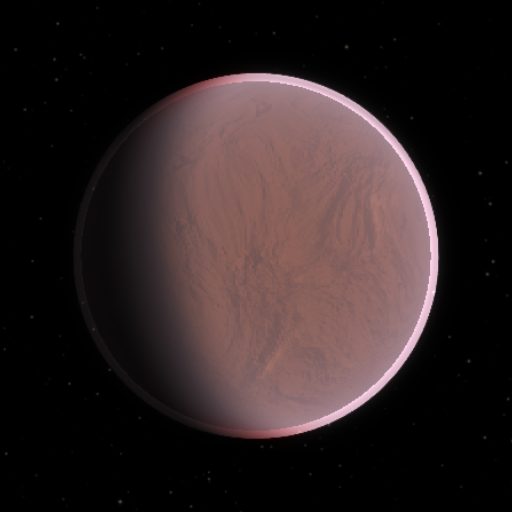
L 98-59 d rendered in TerraForge from its measured mass, orbit and star
TerraForge's rendering of L 98-59 d, generated by our physics engine from its measured mass, size, orbit and star. An illustration of what the science suggests, not a photograph.
TerraForge classification
Barren
Host star
L 98-59 (M3 V)
Distance
35 light-years
Orbit
7.45 days
Mass
1.64 × Earth
Radius
1.63 × Earth
Discovered
2019, transit

Figures from the NASA Exoplanet Archive. The classification is TerraForge’s, from its physics model.

L 98-59 d is the largest of the three transiting planets around L 98-59, a bright red dwarf about 35 light-years away, and the one with the strongest hints of an atmosphere. It orbits every 7.45 days and is about 1.63 times Earth's width. NASA's TESS satellite found it in 2019 together with L 98-59 b and c, by watching for the small dips in starlight as each planet crossed its star.

Its mass, about 1.64 Earth masses, comes from a 2025 study led by Charles Cadieux that combined measurements of the star's wobble with transit timing: L 98-59 c and d pull on each other, so their transits arrive slightly early or late. For its size, that mass makes it less dense than its inner siblings. The study's models suggest water could make up around 16 percent of its mass; an earlier 2021 analysis by Olivier Demangeon's team had allowed up to 30 percent. Whether that means oceans, ice or steam is not known.

In 2024 a team led by Agnibha Banerjee analysed one transit observed by the James Webb Space Telescope and found the spectrum consistent with a heavy atmosphere, possibly containing hydrogen sulfide and sulfur dioxide, gases that could point to volcanoes. They called these signs tentative. In 2026 a team led by Connor Cheverall observed the planet from the ground with the IGRINS spectrograph on the Gemini South telescope and found further evidence for hydrogen sulfide, at a confidence of up to 3.9 sigma. That is the first molecule inferred in a super-Earth's atmosphere from the ground. More observations are needed to confirm it. At an equilibrium temperature of about 420 kelvin, it is too hot for liquid water on its surface.

Sources

  1. The L 98-59 System: Three Transiting, Terrestrial-Sized Planets Orbiting a Nearby M-dwarf — arXiv (The Astronomical Journal)
  2. Detailed Architecture of the L 98-59 System and Confirmation of a Fifth Planet in the Habitable Zone — arXiv (The Astronomical Journal)
  3. Warm terrestrial planet with half the mass of Venus transiting a nearby star — arXiv (Astronomy & Astrophysics)
  4. Atmospheric retrievals suggest the presence of a secondary atmosphere and possible sulfur species on L 98-59 d from JWST NIRSpec G395H transmission spectroscopy — arXiv (The Astrophysical Journal Letters)
  5. Ground-based Atmospheric Characterization of Super-Earth L 98-59 d at High Spectral Resolution — arXiv
A banded gas giant with four moons in different colors: a yellow sulfur moon, two rust-red rock moons and a blue water moon

New: Choose What Your Moons Are Made Of 🌙

Every moon used to be grey rock, white ice or blue ocean, decided for you. Now each one has a "Made of" choice in the builder's Moons tab — silicate rock, iron, water ice, carbon, sulfur, or nitrogen and methane ice — and the physics decides what that becomes. Put water ice too close to the star and it boils off to bare rock. Put sulfur where a neighbouring moon keeps it tidally flexed and it erupts in Io's yellows. Give a Titan-sized moon nitrogen ice far from the sun and it wraps itself in haze. Hang a water moon about the mass of Earth off a giant planet in the habitable zone and it can hold air and open seas — scored for life on the same scale as a planet, with a day as long as its orbit. A tint slider nudges the colour, but only as far as that material could really go.

Create your free account

Enter your email and we'll send a 6-digit code — no password needed.
We only keep your email and the username you choose. We never share or sell your email, and we don't send marketing — we use it only to email you a sign-in code. Read our privacy policy.

Send feedback

We're still building out the best experience we can — and we'd love your input. Tell us about features you enjoy, ideas you'd like to see, or pain points where something feels off, and we'll know where to look next.

Type
Idea
Bug
Pain point
Other