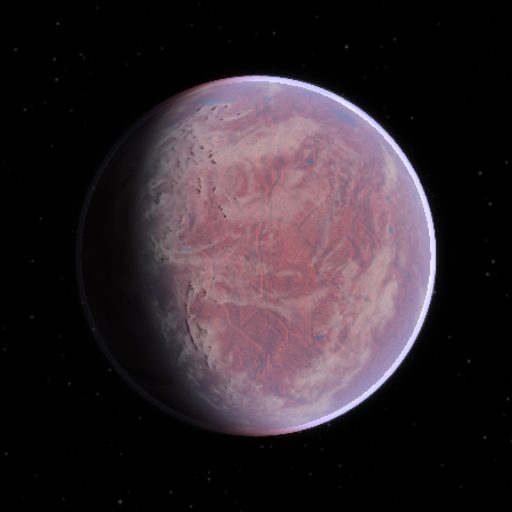
L 98-59 e was the first planet found around L 98-59 that does not pass in front of its star. L 98-59 is a bright red dwarf about 35 light-years away, already known in 2019 to have three transiting planets. In 2021 a team led by Olivier Demangeon, measuring the star with the ESPRESSO spectrograph, found a fourth planet on a 12.8-day orbit.
They used the radial velocity method, which detects the slight back-and-forth motion a planet's gravity gives its star. Because L 98-59 e has never been seen crossing the star, only a minimum mass is known, not its size; a 2025 study led by Charles Cadieux refined that minimum mass to about 2.82 Earth masses. The same 2021 study also reported signs of a fifth planet further out, which was confirmed in 2025 as L 98-59 f.
L 98-59 e sits between the three hot inner planets and the temperate fifth one. The NASA Exoplanet Archive estimates it receives about 2.4 times the light Earth gets from the Sun, with an equilibrium temperature of about 350 kelvin, more than twice what reaches L 98-59 f, the planet that sits in the habitable zone, the range of distances where liquid water could last on a surface. The 2025 study found that all the planets' orbits are nearly circular. With five planets, three of them transiting a bright and nearby star, L 98-59 is one of the best systems for comparing small worlds that formed around the same star.