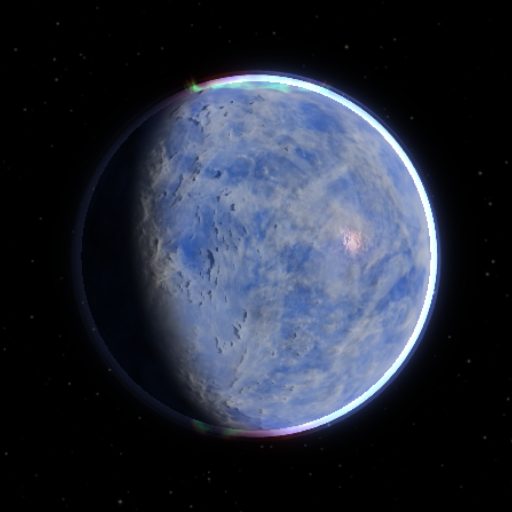
L 98-59 f is a super-Earth in the habitable zone of L 98-59, a bright red dwarf about 35 light-years away. The habitable zone is the range of distances where a planet could keep liquid water on its surface. L 98-59 f orbits every 23.1 days and has a minimum mass of about 2.8 Earth masses. It is the fifth and outermost known planet in the system.
It was first hinted at in 2021, when a team led by Olivier Demangeon found the system's fourth planet, L 98-59 e, with the ESPRESSO spectrograph. They also saw a weaker signal at about 23 days and noted that, if confirmed, it would sit in the middle of the habitable zone. In 2025 two teams confirmed it independently. One, led by Charles Cadieux, reanalysed ESPRESSO and HARPS data with a technique that separates the star's own activity from planetary signals. The other, led by Paul Schwarz, combined HARPS and ESPRESSO measurements with transit data from TESS and Hubble, and estimated its temperature at about 289 kelvin, close to Earth's.
Like L 98-59 e, it does not pass in front of its star, so its size and true mass are unknown, and so is whether it has the air and water that would make it habitable. Schwarz's team also found a possible sixth planet on a 1.7-day orbit, but its statistical significance is modest, between about 2.9 and 4.2 sigma depending on the analysis, so it remains a candidate. L 98-59 is now one of only about 40 known systems with five or more planets.