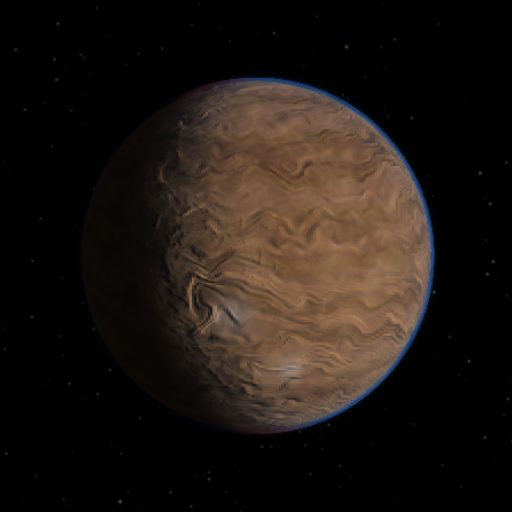
Some researchers have called LHS 1140 b the best current chance to study a potentially habitable world beyond the solar system. A team led by Jason Dittmann of the Harvard-Smithsonian Center for Astrophysics announced it in 2017. The MEarth telescopes caught it passing in front of its star, a small red dwarf about 49 light-years away. The HARPS spectrograph in Chile then confirmed it by measuring how the planet tugs its star back and forth. It orbits every 25 days inside the habitable zone, where liquid water could exist.
Its size and weight make it a puzzle. Precise measurements published in 2024 give 1.73 times Earth's width and 5.6 times its mass. That is too light to be solid rock at its size. Charles Cadieux and colleagues concluded it is either a mini-Neptune wrapped in a thin hydrogen and helium envelope, or a water world whose mass is 9 to 19 percent water.
The James Webb Space Telescope (JWST) has tested those ideas by reading starlight that passes through any atmosphere. Two 2024 studies, one using JWST's NIRISS instrument and one using NIRSpec, both ruled out a hydrogen-rich atmosphere. That argues against the mini-Neptune picture. Both favour a heavier atmosphere, perhaps rich in nitrogen like Earth's. But the nitrogen signal is weak, at about 2.3-sigma, so it is a hint rather than a detection. Mario Damiano's team described the planet as a potentially habitable water world.
Much is still open. The NIRISS team noted the planet could also have no atmosphere at all. A study posted in August 2026 found no helium escaping in four JWST transits, contradicting an earlier ground-based report. Its authors concluded that the planet's nature remains a mystery until more analyses are complete.
TerraForge's model, working only from mass, orbit and star, classifies LHS 1140 b as an ice giant at about 234 K. JWST points away from that: the thick hydrogen envelope a true ice giant needs has been ruled out, so if the planet is icy it is more likely a frozen water world around a rocky core.