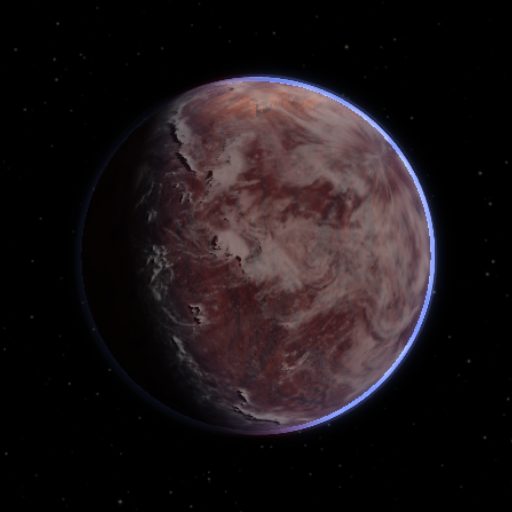
Proxima b orbits Proxima Centauri, the nearest star to the Sun, about 4.2 light-years away. It is roughly Earth's mass, and it sits in its star's habitable zone: the range of distances where a planet's surface could be warm enough for liquid water. That combination makes it a prime target for future telescopes, even though nobody has yet seen it directly.
It was reported in Nature in August 2016 by a team led by Guillem Anglada-Escudé, as part of ESO's Pale Red Dot campaign. They used the radial velocity method. As a planet orbits, it pulls its star slightly back and forth, and that wobble shifts the colour of the starlight. Using the HARPS spectrograph on ESO's 3.6-metre telescope in Chile, the team found Proxima Centauri moving towards and away from us at about walking pace, 5 kilometres per hour, every 11.2 days. The planet orbits about 7 million kilometres from its small, faint star. Later instruments confirmed it. In 2025, measurements with the NIRPS infrared spectrograph put its minimum mass at about 1.06 Earths.
That word, minimum, matters. Radial velocity reveals mass only if we know how the orbit is tilted to our line of sight, and for Proxima b we do not, so the true mass could be higher. Its size is also unknown. In 2019 a study using NASA's Spitzer Space Telescope found that the planet does not pass in front of its star from our point of view. That rules out the transit method, which is how astronomers have measured the sizes and atmospheres of many other small planets. The Spitzer team pointed instead to future infrared telescopes and direct imaging.
The star itself is the biggest question mark. ESO noted that ultraviolet and X-ray flares from Proxima Centauri are far more intense than anything Earth receives from the Sun. In March 2016 the star produced a superflare bright enough, briefly, to be seen with the naked eye. The study of that event estimated that repeated flares like it could strip 90 percent of the ozone from an Earth-like atmosphere within five years. ESO also suggested the planet may always show the same face to its star, with one side in permanent daylight. Whether Proxima b has any atmosphere at all is unknown.
TerraForge's model, working only from its mass, orbit and star, classifies Proxima b as a rocky terrestrial world at 253 K, warmer than the archive's 218 K equilibrium temperature, which counts starlight alone with no greenhouse warming. Because the planet has never been seen to transit, the radius behind that rocky label is an estimate. Rock is a plausible guess for an Earth-mass world, but it has not been tested.