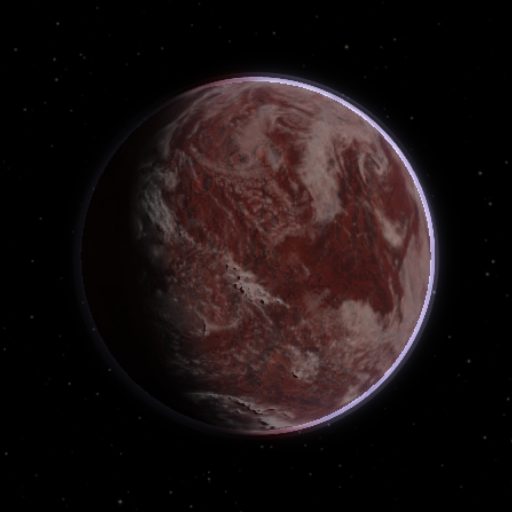
Proxima d is one of the lightest planets ever found by watching a star wobble. It orbits Proxima Centauri, the closest star to the Sun at about 4.2 light-years, and its minimum mass is about a quarter of Earth's, roughly twice the mass of Mars. A team led by João Faria announced it in 2022 from a large set of measurements with ESPRESSO, a spectrograph on the European Southern Observatory's Very Large Telescope in Chile.
The method is called radial velocity. As a planet circles its star, its gravity tugs the star slightly toward and away from us, and that motion shifts the star's light by a tiny amount. Proxima d moves its star by only about 40 centimetres per second. Because the planet has never been seen crossing in front of its star, astronomers know only its minimum mass, not its size.
It circles Proxima every 5.12 days at about 0.029 astronomical units, less than a tenth of Mercury's distance from the Sun. That is closer to the star than its habitable zone, the range of distances where liquid water could last on a surface, so it is probably too hot for oceans. Its neighbour Proxima b, an Earth-mass planet on an 11-day orbit, is the one that sits within that zone.
Red dwarfs like Proxima flicker and flare, and those changes can mimic a planet's signal, which is why the 2022 paper presented Proxima d as a candidate. In 2025 a team led by Alejandro Suárez Mascareño observed the star with NIRPS, a new instrument that measures in infrared light. Combining NIRPS with HARPS and older data, they confirmed Proxima d and found its properties unchanged across instruments and years, with a minimum mass of 0.26 Earth masses. The same study found only inconclusive evidence for Proxima c, a proposed planet on a five-year orbit, so that one remains uncertain.