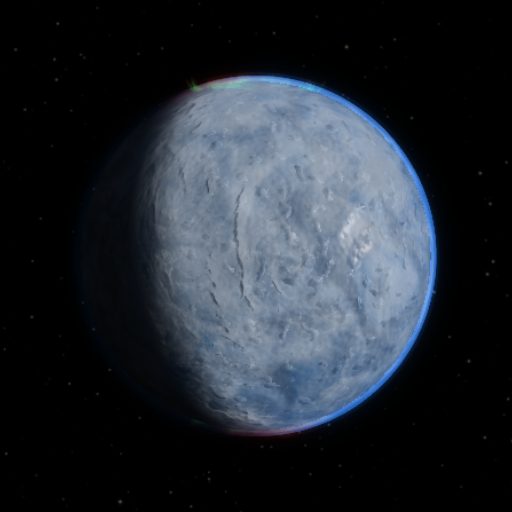
Tau Ceti f orbits near the outer edge of the habitable zone of Tau Ceti, the closest single Sun-like star to us, about 12 light-years away. The habitable zone is the range of distances where a planet could keep liquid water on its surface. Tau Ceti f takes about 640 days to go around its star, and its minimum mass is about four times Earth's.
It was announced as one of four planet candidates in 2017 by a team led by Fabo Feng at the University of Hertfordshire, together with its siblings Tau Ceti e, g and h. A signal near 600 days had been suspected before, and this study pinned it down more precisely. They used the radial velocity method, which detects the slight back-and-forth motion a planet's gravity gives its star. The signals are tiny, as small as 30 centimetres per second, so the team's key step was a new way to remove noise in the data that changes with the colour of the light. That same work ruled out two signals the group had proposed as planets in 2013.
Whether Tau Ceti f could be habitable is far from settled. The discovery team noted that a massive disc of dust and debris around Tau Ceti probably makes life harder for its planets, through heavy bombardment by asteroids and comets. Like its siblings, it has never been seen crossing in front of its star, so its size and true mass are unknown. In 2020 a team led by Jeremy Dietrich used the known planets to predict that at least one more, as yet undetected, planet could orbit in Tau Ceti's habitable zone.