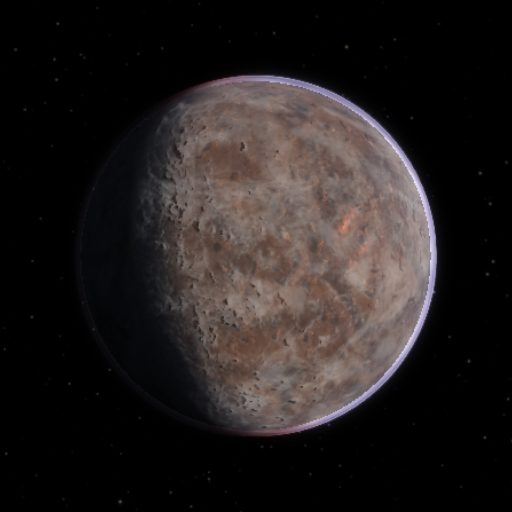
Teegarden's Star c is one of two Earth-mass planets found in 2019 around Teegarden's Star, a very small, dim red dwarf about 12.5 light-years away. With its sibling Teegarden's Star b, it was among the first Earth-mass planets to have their masses measured around such a cool, small star. Teegarden's Star c orbits every 11.4 days and has a minimum mass of about one Earth mass.
A team led by M. Zechmeister found both planets with CARMENES, a spectrograph built to search red dwarfs, using more than 200 measurements. They used the radial velocity method, which detects the slight back-and-forth motion a planet's gravity gives its star. Teegarden's Star is unusually calm for its type, which makes small signals easier to trust, and the team checked the star's brightness to rule out spots imitating planets. They described both as planet candidates.
In 2024 a team led by Stefan Dreizler revisited the star with many new measurements from four instruments: CARMENES, ESPRESSO, MAROON-X and HPF. They confirmed and refined both planets and found a third, Teegarden's Star d, on a 26-day orbit. That study describes b and c as the two planets in the star's habitable zone, the range of distances where liquid water could last on a surface. Teegarden's Star c sits toward the cooler side: according to the NASA Exoplanet Archive, it receives about a third of the light Earth gets from the Sun. It has never been seen passing in front of its star, so its size is unknown, and whether it has an atmosphere or water is an open question.