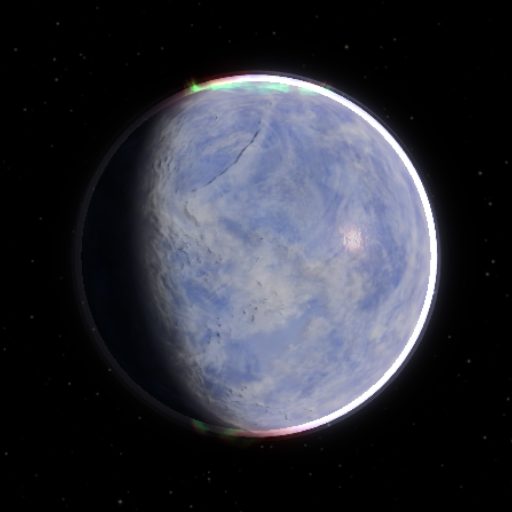
TOI-1266 d is the third planet of TOI-1266, a red dwarf about 117 light-years away, and the only one of the three that does not cross in front of the star. It orbits every 32.5 days and has a mass of about 3.7 Earth masses. It was found largely through its effect on the other two planets.
TOI-1266 b and c were discovered by NASA's TESS satellite in 2020 and are unusual: the larger planet, b, orbits inside the smaller one, c, which researchers call an inverted arrangement. In 2023 a team led by Ryan Cloutier measured the planets' masses with the HARPS-N spectrograph and found a third signal at about 32 days, which they listed as a candidate. In 2024 a team led by Michael Greklek-McKeon measured how the transits of b and c arrive slightly early or late, because of the planets' gravitational tugs on one another. Combining those timing shifts with the earlier measurements, they confirmed TOI-1266 d.
The confirmed system has an odd layout: b and d are close to a 3 to 1 ratio of orbital periods, with c between them out of step. Greklek-McKeon's team found that b and d travel on slightly oval orbits, which may heat b's interior and puff up its atmosphere. According to the NASA Exoplanet Archive, TOI-1266 d receives about 1.3 times the light Earth gets from the Sun, with an estimated equilibrium temperature of about 290 kelvin. Since it does not transit, its size is unknown; the archive's radius is an estimate. Its siblings have low densities that suggest thick gas envelopes, according to a 2024 study led by Dakotah Tyler.