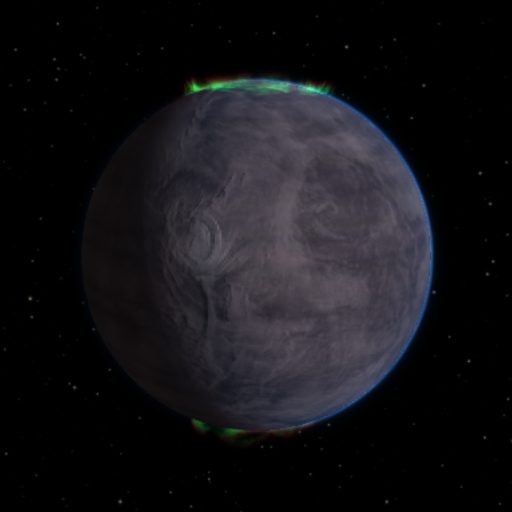
TOI-5120 b is close to a twin of Jupiter in size and mass, about 1.23 times Jupiter's mass and 0.97 times its width, but it circles its star every 24.9 days at 0.17 astronomical units (one astronomical unit is the Earth–Sun distance). NASA's TESS satellite flagged it as a candidate from a regular dip in the starlight, called a transit, as the planet crossed in front of its star. A team led by E. Knudstrup confirmed it in 2026 by measuring the star's slight wobble with two spectrographs, the Tull coudé spectrograph at McDonald Observatory and FIES on the Nordic Optical Telescope, monitoring it from 2022 to 2025. Combining the two methods gives both the planet's size and its mass.
It belongs to a group called warm Jupiters: gas giants on orbits of roughly 8 to 200 days, farther out than the scorching hot Jupiters. Because they sit far enough from their stars that tides do little to reshape their orbits, the shape of a warm Jupiter's orbit keeps a record of how it migrated inward. TOI-5120 b's orbit is slightly stretched, with an eccentricity of 0.10, where zero would be a perfect circle. The team finds that is probably too small for strong tides to be dragging the planet inward at present, so it does not look like a hot Jupiter in the making, though an unseen companion could still stretch its orbit from time to time.
The system has a second surprise. High-resolution imaging revealed a much fainter star about 1.3 arcseconds from the host, roughly 290 astronomical units away from it if the two are bound, and it stayed put between observations in a way that suggests it travels with the host. The authors say this companion might have nudged the planet inward, but that too little is known about it yet to judge. The host star itself is a little more massive than the Sun, slightly evolved and rich in heavy elements, about 230 parsecs away.
The planet is also seen as a possible target for Ariel, a mission designed to survey exoplanet atmospheres, so the team used the CHEOPS space telescope to time two more transits, though they note its expected atmospheric signal is fairly modest. Measuring how its orbit is tilted relative to its star's spin is within reach of many spectrographs.