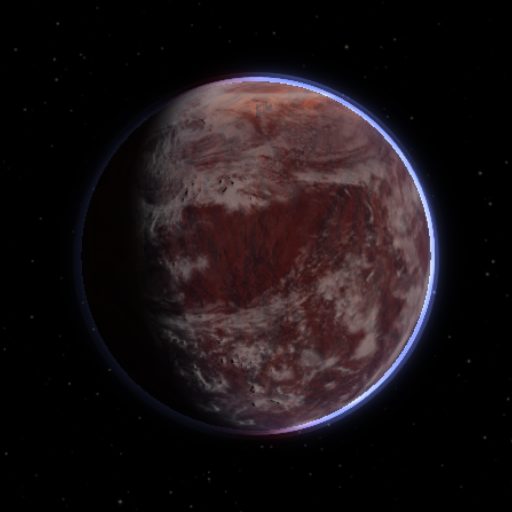
TRAPPIST-1 e is one of very few rocky planets that both sits in its star's habitable zone and can be studied in detail by the James Webb Space Telescope. The habitable zone is the range of distances where, with the right atmosphere, liquid water could last on a planet's surface. Planet e is close to Earth in size, about 0.92 times its width and 0.69 times its mass, and it circles its small red star every 6.1 days.
It was announced in February 2017, when follow-up of the TRAPPIST-1 star with NASA's Spitzer Space Telescope, ESO's Very Large Telescope and other telescopes raised the system's count of known planets to seven. All seven were found by the transit method, which spots the small dip in starlight when a planet passes in front of its star. ESO singled out e, f and g as the planets in the habitable zone that could host oceans of surface water.
Webb watched four transits of e in 2023. The results, published in September 2025 in two papers led by Néstor Espinoza and Ana Glidden, ran into a familiar problem. The star's surface is patchy, with dark spots and bright regions, and those patches leave their own fingerprints in the starlight that can mimic or hide a planet's atmosphere. After accounting for this stellar contamination statistically, the teams ruled out a thick hydrogen-dominated atmosphere, the kind a planet can gather from the gas around a young star. Carbon dioxide atmospheres as thick as those of Venus or Mars were weakly disfavoured. A nitrogen-rich atmosphere with traces of carbon dioxide and methane, broadly like Earth's, still fits the data. So does bare rock.
So nobody yet knows whether e has air at all. A follow-up programme, described by Natalie Allen and colleagues, is timing 15 Webb observations so that e and its inner sibling b cross the star one right after the other along nearly the same path. Planet b appears to be airless, so any feature the two spectra share should come from the star, and anything left over could belong to e. The team expects 15 such pairs could detect an Earth-like atmosphere containing carbon dioxide. Early visits show the method can work, but stellar flares can spoil a pair.
TerraForge's model, working only from e's mass, orbit and star, classifies it as a rocky terrestrial planet at 253 K, close to the archive's equilibrium temperature of 250 K, which is the temperature from starlight alone, with no greenhouse warming. The rocky label matches the measurements. Whether e is a frozen bare rock or a world warmed by a nitrogen atmosphere is exactly what Webb's next observations aim to settle.