Create your free account

Enter your email and we'll send a 6-digit code — no password needed.
We only keep your email and the username you choose. We never share or sell your email, and we don't send marketing — we use it only to email you a sign-in code. Read our privacy policy.
Planet profiles

TRAPPIST-1 h

Ice World · 40 light-years away · Last reviewed October 14, 2026

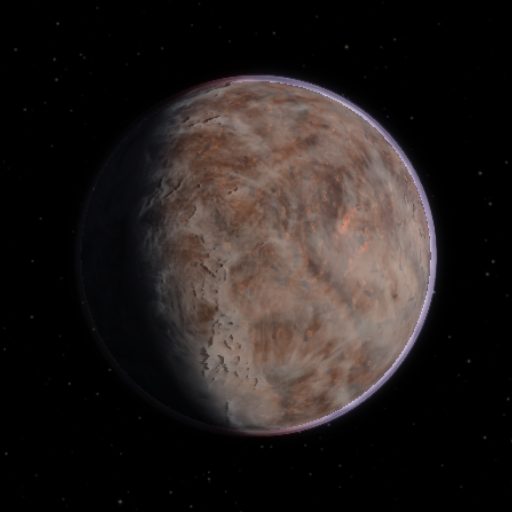
TRAPPIST-1 h rendered in TerraForge from its measured mass, orbit and star
TerraForge's rendering of TRAPPIST-1 h, generated by our physics engine from its measured mass, size, orbit and star. An illustration of what the science suggests, not a photograph.
TerraForge classification
Ice World
Host star
TRAPPIST-1 (M8.0 V)
Distance
40 light-years
Orbit
18.8 days
Mass
0.33 × Earth
Radius
0.76 × Earth
Discovered
2017, transit

Figures from the NASA Exoplanet Archive. The classification is TerraForge’s, from its physics model.

TRAPPIST-1 h is the outermost and smallest of the seven planets around TRAPPIST-1, a small, cool red dwarf about 40 light-years away. It is about three-quarters of Earth's width and about a third of its mass. Its orbit, every 18.77 days, was the last piece of the system's puzzle.

When a team led by Michaël Gillon announced seven planets in 2017, TRAPPIST-1 h's orbital period had not yet been pinned down. Later that year a team led by Rodrigo Luger used new observations from NASA's K2 mission to measure it at 18.77 days. That matched a prediction based on the other planets' orbits. It showed that TRAPPIST-1 h completes a chain in which every neighbouring trio of planets is linked by a three-body resonance, a repeating pattern in their orbits. The same data showed the star rotating every 3.3 days and producing flares consistent with a low-activity, middle-aged red dwarf.

TRAPPIST-1 h receives only about a seventh of the light Earth gets from the Sun. Luger's team estimated its equilibrium temperature, the temperature set by starlight alone, at about 173 kelvin, far below freezing. In 2021 a team led by Eric Agol used years of transit timing to measure all seven masses, putting TRAPPIST-1 h at about 0.33 Earth masses, and found the planets' densities consistent with rocky worlds. Whether it has any atmosphere is unknown.

Sources

  1. A seven-planet resonant chain in TRAPPIST-1 — arXiv (Nature Astronomy)
  2. Seven temperate terrestrial planets around the nearby ultracool dwarf star TRAPPIST-1 — arXiv (Nature)
  3. Refining the transit timing and photometric analysis of TRAPPIST-1: Masses, radii, densities, dynamics, and ephemerides — arXiv (The Planetary Science Journal)
A banded gas giant with four moons in different colors: a yellow sulfur moon, two rust-red rock moons and a blue water moon

New: Choose What Your Moons Are Made Of 🌙

Every moon used to be grey rock, white ice or blue ocean, decided for you. Now each one has a "Made of" choice in the builder's Moons tab — silicate rock, iron, water ice, carbon, sulfur, or nitrogen and methane ice — and the physics decides what that becomes. Put water ice too close to the star and it boils off to bare rock. Put sulfur where a neighbouring moon keeps it tidally flexed and it erupts in Io's yellows. Give a Titan-sized moon nitrogen ice far from the sun and it wraps itself in haze. Hang a water moon about the mass of Earth off a giant planet in the habitable zone and it can hold air and open seas — scored for life on the same scale as a planet, with a day as long as its orbit. A tint slider nudges the colour, but only as far as that material could really go.

Create your free account

Enter your email and we'll send a 6-digit code — no password needed.
We only keep your email and the username you choose. We never share or sell your email, and we don't send marketing — we use it only to email you a sign-in code. Read our privacy policy.

Send feedback

We're still building out the best experience we can — and we'd love your input. Tell us about features you enjoy, ideas you'd like to see, or pain points where something feels off, and we'll know where to look next.

Type
Idea
Bug
Pain point
Other