Create your free account

Enter your email and we'll send a 6-digit code — no password needed.
We only keep your email and the username you choose. We never share or sell your email, and we don't send marketing — we use it only to email you a sign-in code. Read our privacy policy.
Planet profiles

WASP-121 b

Gas Giant · 880 light-years away · Last reviewed October 14, 2026

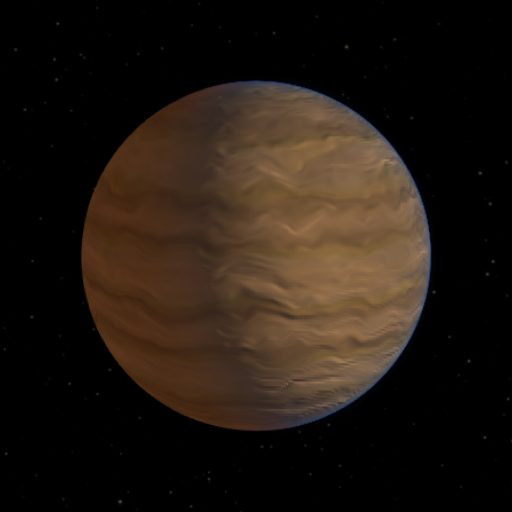
WASP-121 b rendered in TerraForge from its measured mass, orbit and star
TerraForge's rendering of WASP-121 b, generated by our physics engine from its measured mass, size, orbit and star. An illustration of what the science suggests, not a photograph.
TerraForge classification
Gas Giant
Host star
WASP-121 (F6 V)
Distance
880 light-years
Orbit
1.27 days
Mass
372 × Earth
Radius
19.5 × Earth
Discovered
2016, transit

Figures from the NASA Exoplanet Archive. The classification is TerraForge’s, from its physics model.

Few known planets orbit this close to being torn apart. WASP-121 b, also called Tylos, circles its star at only about 1.15 times the Roche limit, the distance at which the star's tidal pull would rip a planet to pieces. It was reported in 2016 by the WASP-South survey, with follow-up from the Euler and TRAPPIST telescopes. The survey uses the transit method, watching for a small, regular dip in a star's light as a planet passes in front of it.

A year on WASP-121 b lasts about 30 hours. It is a gas giant with about 1.2 times Jupiter's mass, but heat has swollen it to roughly 1.7 times Jupiter's width. Its orbit is steeply tilted, carrying it over its star's poles rather than around the equator. Its day side exceeds 3,000 °C, while its night side is around 1,500 °C.

In 2025 it became the first exoplanet whose atmosphere was mapped in three dimensions. A team led by Julia Victoria Seidel of the European Southern Observatory combined the light of all four Very Large Telescope units in Chile and fed it to the ESPRESSO spectrograph. They found three layers: iron winds deep down, a fast jet stream of sodium wrapping around the equator above them, and hydrogen winds on top. A companion study found titanium just below the jet stream. Earlier observations had suggested titanium was missing.

Later that year, the James Webb Space Telescope's NIRSpec instrument detected water vapour, carbon monoxide, methane and silicon monoxide. It was the first detection of silicon monoxide in a planet's atmosphere. From this chemistry, the researchers argue the planet gathered most of its gas in a cold part of its birth disc, between the equivalent orbits of Jupiter and Uranus, and only later ended up close to its star. That conclusion rests on models of how planets form, so it is an interpretation, not a direct measurement. The methane on the cooler night side was unexpected. The team suggests strong vertical currents lift it from deeper layers, which challenges current models of how gas circulates on such planets.

TerraForge's model, working only from its mass, orbit and star, classifies WASP-121 b as a gas giant, which matches. Its modelled temperature of 2,512 K is close to the archive's equilibrium temperature of 2,409 K, but the real planet is far from uniform, with a day side above 3,200 K and a much cooler night side.

Sources

  1. WASP-121 b: a hot Jupiter in a polar orbit and close to tidal disruption — Monthly Notices of the Royal Astronomical Society (arXiv:1506.02471)
  2. “Out of science fiction”: First 3D observations of an exoplanet’s atmosphere reveal a unique climate — European Southern Observatory (eso2504)
  3. Webb reveals the origin of the ultra-hot exoplanet WASP-121b — Max Planck Institute for Astronomy
A banded gas giant with four moons in different colors: a yellow sulfur moon, two rust-red rock moons and a blue water moon

New: Choose What Your Moons Are Made Of 🌙

Every moon used to be grey rock, white ice or blue ocean, decided for you. Now each one has a "Made of" choice in the builder's Moons tab — silicate rock, iron, water ice, carbon, sulfur, or nitrogen and methane ice — and the physics decides what that becomes. Put water ice too close to the star and it boils off to bare rock. Put sulfur where a neighbouring moon keeps it tidally flexed and it erupts in Io's yellows. Give a Titan-sized moon nitrogen ice far from the sun and it wraps itself in haze. Hang a water moon about the mass of Earth off a giant planet in the habitable zone and it can hold air and open seas — scored for life on the same scale as a planet, with a day as long as its orbit. A tint slider nudges the colour, but only as far as that material could really go.

Create your free account

Enter your email and we'll send a 6-digit code — no password needed.
We only keep your email and the username you choose. We never share or sell your email, and we don't send marketing — we use it only to email you a sign-in code. Read our privacy policy.

Send feedback

We're still building out the best experience we can — and we'd love your input. Tell us about features you enjoy, ideas you'd like to see, or pain points where something feels off, and we'll know where to look next.

Type
Idea
Bug
Pain point
Other