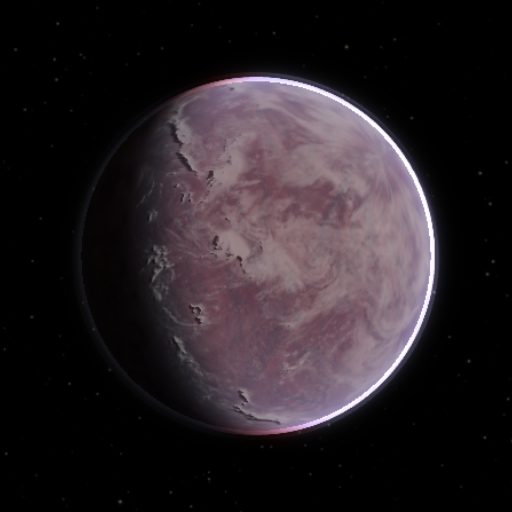
YZ Ceti d is the outermost of three Earth-mass planets around YZ Ceti, a small red dwarf about 12 light-years away. It orbits every 4.66 days and has a minimum mass of about 1.09 Earth masses. It was discovered together with YZ Ceti b and c.
The three were reported in 2017 by a team led by N. Astudillo-Defru, from measurements with the HARPS spectrograph in Chile. They used the radial velocity method, which picks up the slight back-and-forth motion a planet's gravity gives its star. YZ Ceti d's period was the most secure from the start: when a 2018 reanalysis questioned whether the inner planets' periods had been misread because of gaps in when the star could be observed, the 4.66-day signal was not in doubt. In 2020 a CARMENES team led by S. Stock added 229 new measurements, resolved those questions for all three planets, and modelled the star's own activity alongside the planets.
The whole system fits inside an orbit less than a tenth the size of Mercury's, which the 2020 paper calls ultra-compact. Being the farthest out, YZ Ceti d is the coolest of the three, though still far too hot for liquid water; the archive estimates its equilibrium temperature, set by starlight alone, at about 360 kelvin. None of the planets has been seen passing in front of the star in data from NASA's TESS satellite, so their sizes are unknown. The 2017 team also noted a possible fourth, even lighter planet on a one-day orbit, which has not been confirmed.