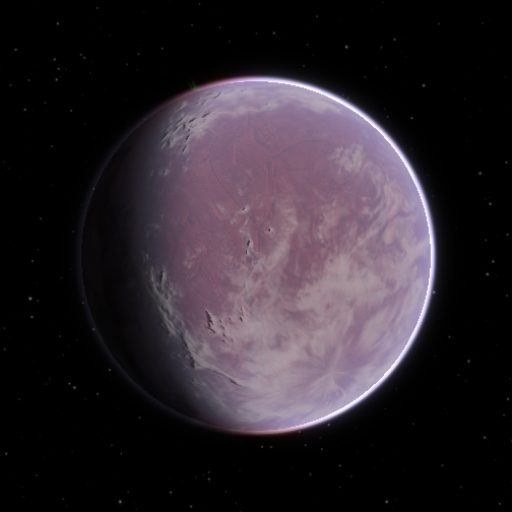
LHS 1140 c
Also written LHS 1140c
- Mass
- 1.91 × Earth
- Radius
- 1.27 × Earth
- Gravity
- 1.18 g
- Surface (est.)
- 435 K
- Year
- 3.8 days
- From Earth
- 48.9 ly
- Mass
- 1.91 × Earth
- Radius
- 1.27 × Earth
- Gravity
- 1.18 g
- Surface (est.)
- 435 K
- Year
- 3.8 days
- From Earth
- 48.9 ly
LHS 1140 system
- Type
- M-type (Red Dwarf)
- Spectral type
- M4.5 V
- Temperature
- 3,096 K
- Radius
- 0.216 ☉
- Mass
- 0.184 ☉
- Planets
- 2
- Luminosity
- 3.80e-3 ☉
Published by the NASA Exoplanet Archive. This world’s temperature and habitability score are computed from this star’s measured luminosity, not from a stand-in for its class.
 LHS 1140 c0.027 AUYou are here1.9 M⊕
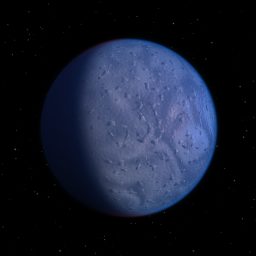
Star and planets drawn to scale: the star is 19 times as wide as LHS 1140 c, so only its edge is in view. Orbits spaced as in the star system view.
LHS 1140 c, from the NASA Exoplanet Archive (found 2018). Measured: 1.91 Earth masses, 0.027 AU, a 3096 K M-type star. Composition inferred from a measured bulk density of 0.93x Earth's at this size, suggesting roughly 12% water/ice by mass, with a day locked to its 3.8-day year, as anything orbiting this close would be.
Surface. Rocky surface with impact craters, possible volcanic features


Thin CO₂ and nitrogen atmosphere
Nitrogen atmosphere provides protection but not breathable