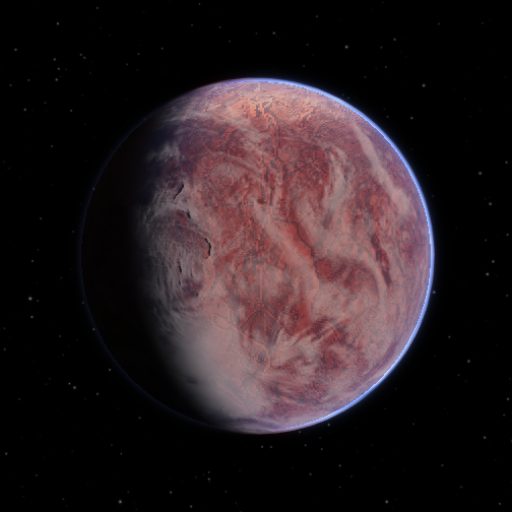
LTT 1445 Ad
Rocky TerrestrialMarginal22 light years awayFound 2022
exoplanet.euListed by the Extrasolar Planets Encyclopaedia; not yet in NASA's confirmed catalogue.View on exoplanet.eu
Estimated: this planet doesn't transit its star, so its size is inferred, not measured
LTT 1445 Ad, from the Extrasolar Planets Encyclopaedia (found 2022). Measured: 2.72 Earth masses, 0.09 AU, a 3340 K M-type star. Composition inferred from an estimated bulk density of 0.87x Earth's, modeled rather than measured since this isn't a transiting planet — the radius is the archive's estimate, so it can't settle how much water there is; read as rock and iron, with a day locked to its 24.3-day year, as anything orbiting this close would be.
LTT 1445 A
- Type
- M-type (Red Dwarf)
- Spectral type
- M3.5V
- Temperature
- 3,340 K
- Radius
- 0.27 ☉
- Mass
- 0.256 ☉
- Known planets
- 3, including this one
- Luminosity
- 8.17e-3 ☉
Published by the Extrasolar Planets Encyclopaedia. This world’s temperature and habitability score are computed from its star’s published radius and temperature.
Rocky Terrestrial
Life possibleHigh Activity
Why is this a Rocky Terrestrial?
LTT 1445 Ad is dominated by silicate (25.0%) and iron (12.5%) content, forming a rocky terrestrial body.Rocky terrestrial planets are primarily composed of silicate rocks and metals. They're the most common type of small planet in the universe.
Classification Criteria:
✓ Silicon: 25.0% + Iron: 12.5% + Magnesium: 3.8%✓ Mass: 2.7x Earth (terrestrial range)


Habitability ScoreMarginal
Contributing Factors
temperature100
Optimal temperature range for liquid water and life
atmosphere28
Nitrogen atmosphere provides protection but not breathable (partially stripped by slow rotation)
water50
Limited water content
magnetic Field30
No magnetic field - vulnerable to solar radiation
geology90
Active geology recycles nutrients and drives carbon cycle
Organic Chemistry80
Core organic elements (CHNO) present
rotation10
Near tidally locked - one hemisphere perpetually scorched, other frozen, narrow habitable twilight zone only
Physical Properties
Mass
2.72x Earth (1.62e+25 kg)Radius
1.40x Earth (8,893 km)Surface Gravity
1.40x Earth (13.7 m/s²)Surface Temperature
283 K (10 °C / 49 °F)Rotation Period
583.2 hours/day (slower than Earth)Orbital Environment
Star Type
M-type (Red Dwarf)Distance from Star
0.09 AU (13.5 million km)Orbital Period
18 daysAtmosphere
Thin CO₂ and nitrogen atmosphere
Elemental Composition
O - Oxygen
31.3%
Si - Silicon
25.0%
Fe - Iron
12.5%
Surface Characteristics
Rocky surface with impact craters, possible volcanic featuresHabitability
✓ Conditions could support lifeThis planet’s modelled conditions could support biological processes: stable temperatures, liquid water and the chemistry life as we know it needs. That makes life possible, not present.Love TerraForge? Please help support us.Keeps it ad-free, and funds new features and hosting.