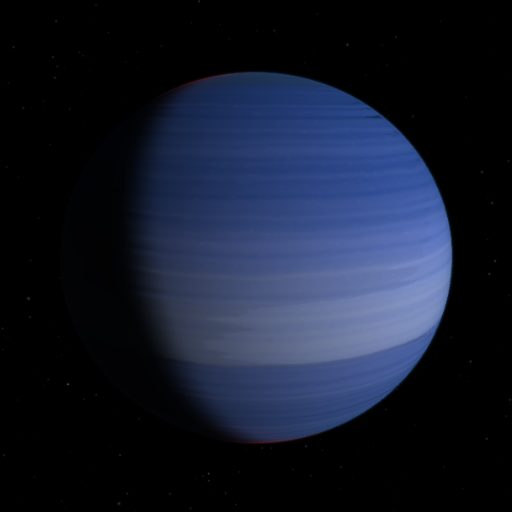
SCR J1214-2345 b
Also written SCR J1214-2345b, SCR J1214 2345b, SCR J1214 2345 b
- Mass
- 3180.00 × Earth
- Radius (est.)
- 12.40 × Earth
- Gravity (est.)
- 20.68 g
- Surface (est.)
- 4 K
- Year (est.)
- 12,994 years
- From Earth
- 35.2 ly
- Mass
- 3180.00 × Earth
- Radius (est.)
- 12.40 × Earth
- Gravity (est.)
- 20.68 g
- Surface (est.)
- 4 K
- Year (est.)
- 12,994 years
- From Earth
- 35.2 ly
SCR J1214-2345 system
- Type
- M-type (Red Dwarf)
- Spectral type
- M4Ve
- Temperature
- 3,097 K
- Radius
- 0.205 ☉
- Mass
- 0.174 ☉
- Planets
- 1
- Luminosity
- 3.48e-3 ☉
Published by the Extrasolar Planets Encyclopaedia. This world’s temperature and habitability score are computed from its star’s published radius and temperature.
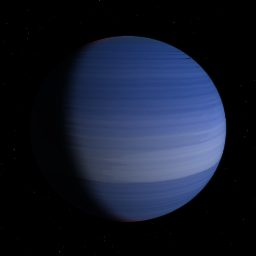 SCR J1214-2345 b370.00 AUYou are here3,180 M⊕
Star and planets drawn to scale: the star is 1.8 times as wide as SCR J1214-2345 b, so only its edge is in view. Orbits spaced as in the star system view.
Estimated: this planet doesn't transit its star, so its size is inferred, not measured
SCR J1214-2345 b, from the Extrasolar Planets Encyclopaedia (found 2021). Measured: 3180 Earth masses, 370 AU, a 3097 K M-type star. Composition inferred from a mass of 3180 Earths, which is giant territory whatever its 1.67x density suggests, with an assumed 10-hour day, typical of giant planets (Jupiter 9.9 h) — rotation cannot be measured for exoplanets. Note: TerraForge comes out at 4 K against the archive's 666 K, because that figure is the planet's own heat, not the star's. It receives almost no sunlight out at this distance and is still glowing from its formation — TerraForge only warms worlds with starlight, so it has no way to model a planet heated from within.
Surface. No solid surface - thick gaseous envelope with possible rocky core deep within

Hydrogen and helium dominated with trace methane and ammonia
Hydrogen-rich atmosphere typical of gas giants