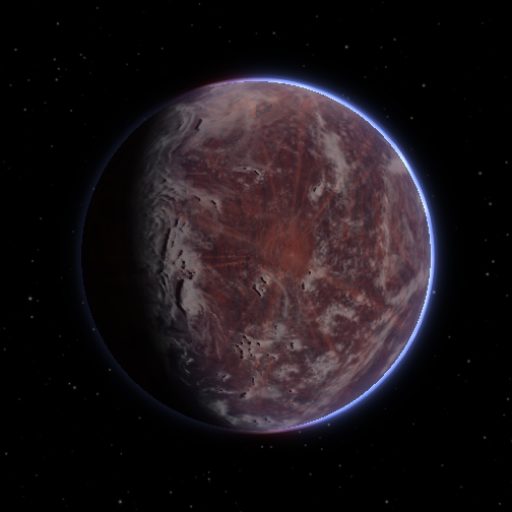
Teegarden's Star b
Also written Teegarden's Starb
- Mass
- 1.16 × Earth
- Radius
- 1.05 × Earth
- Gravity
- 1.05 g
- Surface (est.)
- 287 K
- Year
- 4.9 days
- From Earth
- 12.5 ly
- Mass
- 1.16 × Earth
- Radius
- 1.05 × Earth
- Gravity
- 1.05 g
- Surface (est.)
- 287 K
- Year
- 4.9 days
- From Earth
- 12.5 ly
Teegarden's Star system
- Type
- M-type (Red Dwarf)
- Spectral type
- M7.0 V
- Temperature
- 3,034 K
- Radius
- 0.12 ☉
- Mass
- 0.097 ☉
- Planets
- 3
- Luminosity
- 7.22e-4 ☉
Published by the NASA Exoplanet Archive. This world’s temperature and habitability score are computed from this star’s measured luminosity, not from a stand-in for its class.
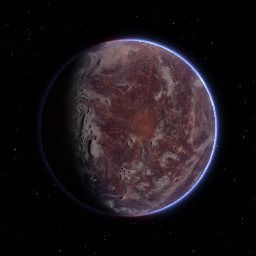 Teegarden's Star b0.026 AUYou are here1.2 M⊕
Star and planets drawn to scale: the star is 12 times as wide as Teegarden's Star b, so only its edge is in view. Orbits spaced as in the star system view.
Estimated: this planet doesn't transit its star, so its size is inferred, not measured
Few known planets come closer to Earth's basic numbers than Teegarden's Star b. It gets about 1.08 times as much starlight as Earth does. Its equilibrium temperature, the temperature it would reach from starlight alone with no greenhouse warming, is about 277 K, a few degrees above freezing. And its minimum mass is about 1.16 Earths. A 2024 study gave it an Earth Similarity Index of 0.90, a rough score from 0 to 1 of how closely a planet's basic properties match Earth's.
Surface. Rocky surface with impact craters, possible volcanic features
✓ Conditions could support life. This planet’s modelled conditions could support biological processes: stable temperatures, liquid water and the chemistry life as we know it needs. That makes life possible, not present.


Thin CO₂ and nitrogen atmosphere
Nitrogen atmosphere provides protection but not breathablePhysical Properties
Time Dilation
Clocks run 5.4 seconds per year slower than deep space — about 7 minutes over a lifetimeElemental Composition
How TerraForge built this world
Teegarden's Star b, from the NASA Exoplanet Archive (found 2019). Measured: 1.16 Earth masses, 0.0259 AU, a 3034 K M-type star. Composition inferred from an estimated bulk density of 1.00x Earth's, modeled rather than measured since this isn't a transiting planet — the radius is the archive's estimate, so it can't settle how much water there is; read as rock and iron, with a day locked to its 4.9-day year, as anything orbiting this close would be.