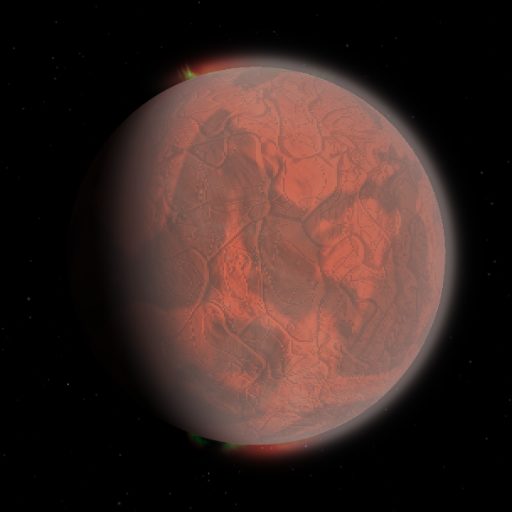
TOI-2079 c
Also written TOI-2079c, TOI 2079c, TOI 2079 c
- Mass
- 5.09 × Earth
- Radius
- 1.67 × Earth
- Gravity
- 1.83 g
- Surface (est.)
- 491 K
- Year
- 9.3 days
- From Earth
- 121 ly
- Mass
- 5.09 × Earth
- Radius
- 1.67 × Earth
- Gravity
- 1.83 g
- Surface (est.)
- 491 K
- Year
- 9.3 days
- From Earth
- 121 ly
TOI-2079 system
- Type
- M-type (Red Dwarf)
- Spectral type
- M1.5V
- Temperature
- 3,695 K
- Radius
- 0.479 ☉
- Mass
- 0.475 ☉
- Planets
- 2
- Luminosity
- 0.0386 ☉
Published by the Extrasolar Planets Encyclopaedia. This world’s temperature and habitability score are computed from its star’s published radius and temperature.
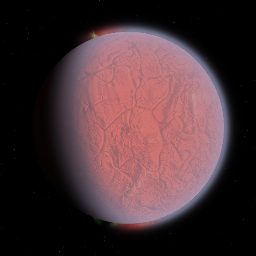
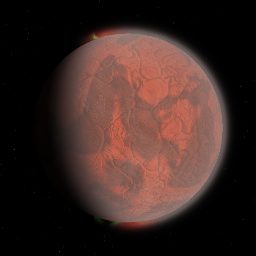 TOI-2079 c0.068 AUYou are here5.1 M⊕
Star and planets drawn to scale: the star is 31 times as wide as TOI-2079 c, so only its edge is in view. Orbits spaced as in the star system view.
Rocky Terrestrial, likely · its density could also fit a sub-Neptune
TOI-2079 c, from the Extrasolar Planets Encyclopaedia (found 2026). Measured: 5.09 Earth masses, 0.068 AU, a 3695 K M-type star. Composition inferred from a measured bulk density of 1.09x Earth's at this size, suggesting roughly 13% water/ice by mass, with a day locked to its 9.3-day year, as it is predicted to be tidally locked: at this distance its star would have stopped its spin within a million years.
Surface. Rocky surface with impact craters, possible volcanic features

Thin CO₂ and nitrogen atmosphere
Nitrogen atmosphere provides protection but not breathable