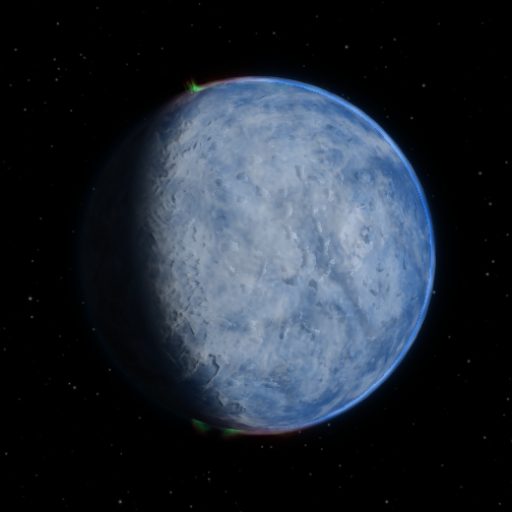
TOI-561 f
Also written TOI-561f, TOI 561f, TOI 561 f
Ice WorldHabitable280 light years awayFound 2020
exoplanet.euListed by the Extrasolar Planets Encyclopaedia; not yet in NASA's confirmed catalogue.View on exoplanet.eu
TOI-561 f, from the Extrasolar Planets Encyclopaedia (found 2020). Measured: 19.1 Earth masses, 1.03 AU, a 5326 K G-type star. Composition inferred from a measured bulk density of 1.53x Earth's at this size, suggesting roughly 6% water/ice by mass, with an assumed 24-hour day — rotation cannot be measured for exoplanets.
TOI-561
- Type
- G-type (Yellow (Sun-like))
- Temperature
- 5,326 K
- Radius
- 0.832 ☉
- Mass
- 0.805 ☉
- Known planets
- 5, including this one
- Luminosity
- 0.502 ☉
Published by the Extrasolar Planets Encyclopaedia. This world’s temperature and habitability score are computed from its star’s published radius and temperature.
Ice World
Life unlikely — too cold for liquid waterMagnetic FieldLow Activity
Why is this a Ice World?
TOI-561 f orbits at 1.03 AU from its star, resulting in frigid temperatures of 237K.Ice worlds form beyond the frost line where temperatures are low enough for water and other volatiles to freeze solid. They may have subsurface oceans beneath thick ice shells.
Classification Criteria:
✓ Distance: 1.03 AU (>3 AU) or Temperature <200K✓ Temperature: 237K✓ Water content: 36.2% for ice formation



Habitability ScoreHabitable
Contributing Factors
temperature40
Extreme temperature - very difficult for life
atmosphere70
Nitrogen atmosphere provides protection but not breathable
water62
Good water content - mostly frozen
magnetic Field100
Magnetic field provides radiation protection
geology60
Some geological activity provides slow nutrient cycling
Organic Chemistry80
Core organic elements (CHNO) present
rotation100
Optimal rotation period - balanced day/night cycle, moderate weather, and good heat distribution
Physical Properties
Mass
19.10x Earth (1.14e+26 kg)Radius
2.67x Earth (17,030 km)Surface Gravity
2.67x Earth (26.2 m/s²)Surface Temperature
237 K (-37 °C / -34 °F)Rotation Period
24.0 hours/dayOrbital Environment
Star Type
G-type (Yellow (Sun-like))Distance from Star
1.03 AU (154 million km)Orbital Period
1.05 yearsAtmosphere
Thin nitrogen and methane atmosphere
Elemental Composition
O - Oxygen
31.1%
Si - Silicon
23.5%
Fe - Iron
11.8%
Surface Characteristics
Frozen surface covered in water ice, possible subsurface ocean if tidal heating presentLove TerraForge? Please help support us.Keeps it ad-free, and funds new features and hosting.