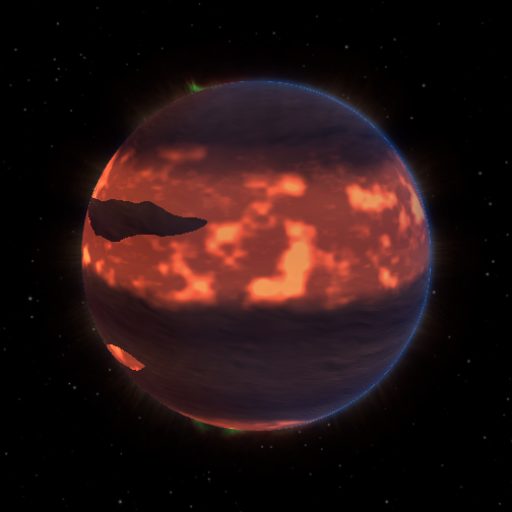
UPM J1040-3551 Bb
Also written UPM J1040 3551 Bb
Brown DwarfUninhabitable82 light years awayFound 2025
exoplanet.euListed by the Extrasolar Planets Encyclopaedia; not yet in NASA's confirmed catalogue.View on exoplanet.eu
Estimated: this planet doesn't transit its star, so its size is inferred, not measured
UPM J1040-3551 Bb, from the Extrasolar Planets Encyclopaedia (found 2025). Measured: 5720 Earth masses, 1660 AU, a 3200 K M-type star. Composition inferred from a mass of 5720 Earths, which is giant territory whatever its 3.23x density suggests, with an assumed 24-hour day — rotation cannot be measured for exoplanets.
UPM J1040-3551
- Type
- M-type (Red Dwarf)
- Spectral type
- M4V
- Temperature
- 3,200 K
- Radius
- 0.262 ☉
- Mass
- 0.235 ☉
- Known planets
- 2, including this one
- Luminosity
- 6.48e-3 ☉
Published by the Extrasolar Planets Encyclopaedia. This world’s temperature and habitability score are computed from its star’s published radius and temperature.
Brown Dwarf
Magnetic FieldNone Activity
Why is this a Brown Dwarf?
UPM J1040-3551 Bb has an unusual composition that doesn't fit standard classifications, or lacks the elements needed for complex geological processes.Barren worlds can form from uncommon element combinations or may be remnants of larger bodies that lost their atmospheres and volatile materials.
Classification Criteria:
Composition doesn't match standard planet typesMass: 5720.0x EarthTemperature: 751K


Habitability ScoreUninhabitable
Contributing Factors
temperature5
Scorching - hot enough to melt lead, though rock stays solid; no chance for life
atmosphere30
Hydrogen-rich atmosphere typical of gas giants
water15
No solid surface — any water is locked in a supercritical mantle and hot ice, not oceans
magnetic Field20
A strong field, but no surface beneath it — there is nothing here for it to shelter
geology30
Geologically dead - no nutrient recycling
Organic Chemistry80
Core organic elements (CHNO) present
rotation100
Optimal rotation period - balanced day/night cycle, moderate weather, and good heat distribution
Physical Properties
Mass
5720.00x Earth (3.42e+28 kg)Radius
17.88x Earth (113,939 km)Surface Gravity
17.88x Earth (175.4 m/s²)Surface Temperature
751 K (477 °C / 891 °F)Rotation Period
24.0 hours/dayOrbital Environment
Star Type
M-type (Red Dwarf)Distance from Star
1660.00 AU (248 billion km)Orbital Period
123,481 yearsAtmosphere
Hydrogen and helium dominated by methane absorption, with water clouds below
Elemental Composition
H - Hydrogen
53.8%
He - Helium
32.3%
O - Oxygen
5.4%
Surface Characteristics
No surface: a cooling failed star, its methane atmosphere absorbing so much red light it would look magenta to the eyeLove TerraForge? Please help support us.Keeps it ad-free, and funds new features and hosting.