Entering orbit…
AI assistant
Habitability
0/ 100
View planet
View star system
View surface
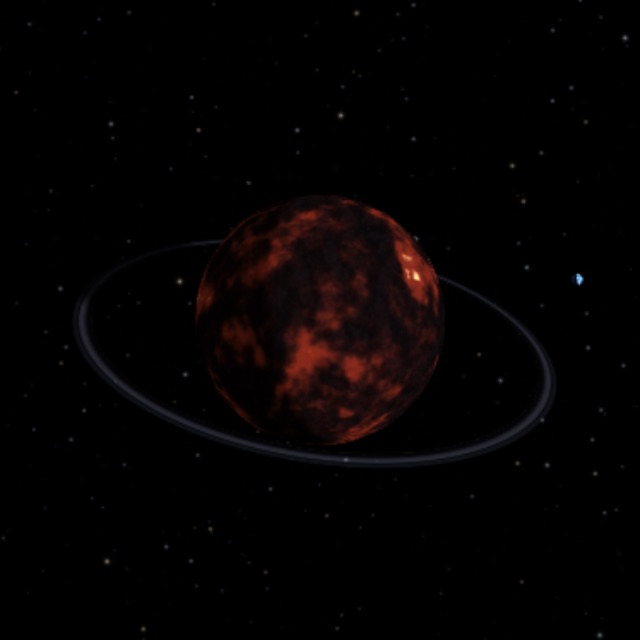
Korrune GT-5677B
Volcanic World
- Mass
- 5.30 × Earth
- Radius
- 1.74 × Earth
- Gravity
- 1.74 g
- Surface
- 264 K
- Year
- 13.1 years
- Day
- 1.0 hrs
- Mass
- 5.30 × Earth
- Radius
- 1.74 × Earth
- Gravity
- 1.74 g
- Surface
- 264 K
- Year
- 13.1 years
- Day
- 1.0 hrs
Korrune GT-5677B's star
A-type · Blue-White
Korrune GT-5677B7.01 AUVolcanic WorldYou are hereHabitable zone
Star and planet drawn to scale (a typical star of its class), with only the star's edge in view. Orbits spaced as in the star system view.
Korrune GT-5677B's moons
3 moons
Moon 2Ice · 32,200 km
Moon 4Rock · 145,200 km
Moon 5Ocean · 48,900 km
Planet, moons and orbits drawn to one scale; the smallest moons are enlarged so they can be seen.
An lava world with magma seas and with a little weak atmosphere, with active volcanoes
Surface. Runaway tidal heating drives volcanism across a cold crust - lava lakes and sulfur plains between frozen plains
Volcanic World
Magnetic FieldExtreme Activity
Resonant, close-in moons pump orbital eccentricity, and the resulting tidal flexing dissipates enormous heat in the interior. Only a fraction of the surface is molten at once, so the ground between the vents stays as cold as the orbit allows - Io's own equilibrium temperature is about 110 K.
Classification Criteria:
✓ Close-in moons in a resonant configuration✓ Tidal heat flux beyond the runaway threshold- The orbit is not what melted it: 7.01 AU, 264K equilibrium
Habitability ScoreUninhabitable
Contributing Factors
water0
No water - the recipe has no hydrogen and oxygen to form it
geology40
Extreme volcanic activity may be hazardous
rotation10
Near tidally locked - one hemisphere perpetually scorched, other frozen, narrow habitable twilight zone only
Organic Chemistry20
Limited organic chemistry potential
atmosphere16
Volcanic outgassing - sulfur compounds and vaporized rock
Atmosphere present but composition not ideal for life (partially stripped by slow rotation)temperature0
Challenging but potentially habitable temperature (runaway tidal heating keeps the surface molten regardless of orbit)
magnetic Field100
Magnetic field provides radiation protection
Physical Properties
Mass
5.30x Earth (3.17e+25 kg)Radius
1.74x Earth (11,108 km)Surface Gravity
1.74x Earth (17.1 m/s²)Surface Temperature
264 K (-9 °C / 16 °F)Rotation Period
1.0 hours/day (faster than Earth)Elemental Composition
Closest Real Exoplanet
HD 283869 b81% similar
Orbiting HD 283869| Yours | HD 283869 b | |
|---|---|---|
| Mass | 5.30 × Earth | 6.52 × Earth |
| Radius | 1.58 × Earth | 1.96 × Earth |
| Density (composition) | 7.41 g/cm³ | 4.77 g/cm³ |
| Temperature | 264.1 K | 255.0 K |
| Starlight received | 0.81 × Earth | 1.15 × Earth |
| Star temperature | 8,750 K | 4,655 K |
Moons
Moon 1rings
Inside the Roche limit (1.92 planet radii): torn apart into a ring system.
Moon 2stable
Small and distant: a quiet, stable companion.
Tidal braking locked the planet to its moon: one face forever moonward.
Moon 3merged
Merged with an adjacent moon: too close for both to hold a stable orbit.
Moon 4stableIce lost: bare rock
Small and distant: a quiet, stable companion.
Too warm for nitrogen and methane frost and too small to hold them as an atmosphere: those ices escaped to space, leaving water ice.
Too warm for ice and too small to hold an atmosphere: the ice sublimated, leaving bare rock.
Moon 5stableOcean world
Small and distant: a quiet, stable companion.
A thin tidal-warmed subsurface ocean may exist, but conditions are marginal (28/100).
-85 temperature: runaway tidal heating keeps the surface molten regardless of orbit