Entering orbit…
AI assistant
Habitability
13/ 100
View planet
View star system
View surface
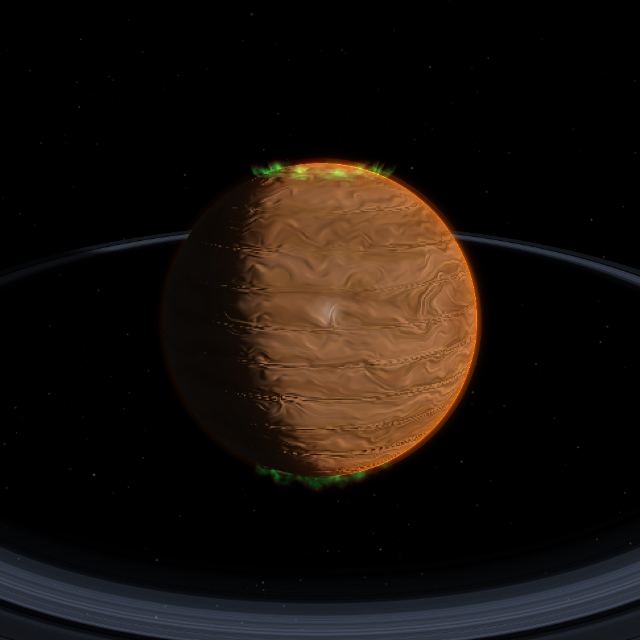
Thýella
- Mass
- 8.00 × Earth
- Radius
- 2.00 × Earth
- Gravity
- 2.00 g
- Surface
- 188 K
- Year
- 40.9 days
- Day
- 45.0 hrs
- Mass
- 8.00 × Earth
- Radius
- 2.00 × Earth
- Gravity
- 2.00 g
- Surface
- 188 K
- Year
- 40.9 days
- Day
- 45.0 hrs
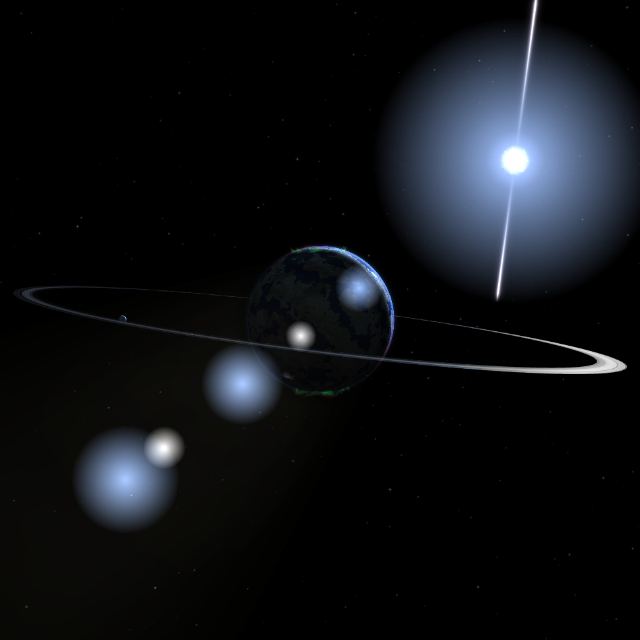
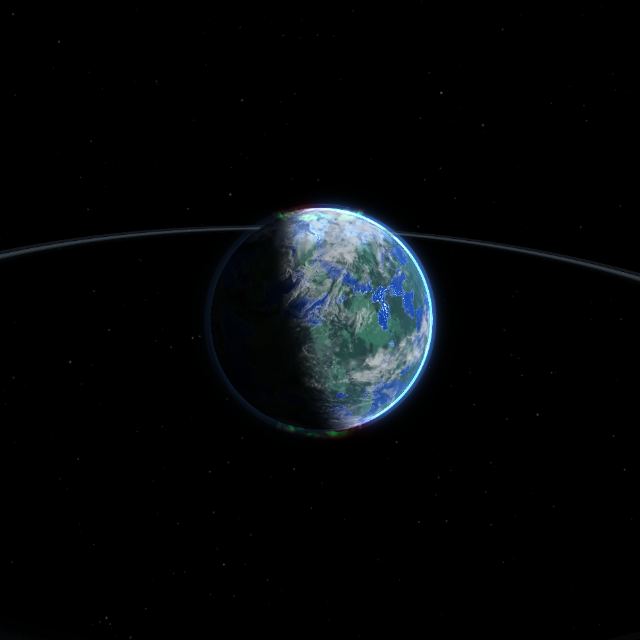
Habitable zone
Star and planets drawn to scale (a typical star of its class), with only the star's edge in view. Orbits spaced as in the star system view.
A gas planet with a super-extreme climate. It contains massive superstorms that move at speeds of over 4,566 km/h.
Surface. No solid surface - a thick gas envelope wrapped around a small deep core (a mini-Neptune)
Sub-Neptune
✦ Gallaghar System
Your planet is a sub-Neptune: a 8.0x Earth core wrapped in a deep hydrogen-helium envelope, with no solid surface to stand on.Magnetic FieldLow Activity
Sub-Neptunes are the most common planets Kepler found, though our own solar system has none. Too light to be a giant, they still hold on to a thick envelope of light gas over a rocky or icy core.
Classification Criteria:
✓ Mass: 8.0x Earth (under 20x, below the giants)✓ A hydrogen-helium envelope over the core
Habitability ScoreUninhabitable
Contributing Factors
water15
No solid surface — any water is locked in a supercritical mantle and hot ice, not oceans
geology60
Some geological activity provides slow nutrient cycling
rotation65
Slow rotation - significant day/night temperature variations, but life can adapt
Organic Chemistry50
Carbon and hydrogen present - organic chemistry possible
atmosphere30
Deep hydrogen-helium envelope with photochemical haze
Hydrogen-rich atmosphere typical of gas giantstemperature20
Very cold - water frozen, challenging for life
magnetic Field100
Magnetic field provides radiation protection — but the pulsar's beams bathe this orbit in hard X-rays
Physical Properties
Mass
8.00x Earth (4.78e+25 kg)Radius
2.00x Earth (12,742 km)Surface Gravity
2.00x Earth (19.6 m/s²)Surface Temperature
188 K (-85 °C / -121 °F)Rotation Period
45.0 hours/day (slower than Earth)Elemental Composition
Closest Real Exoplanet
GJ 229 A c91% similar
Orbiting GJ 229| Yours | GJ 229 A c | |
|---|---|---|
| Mass | 8.00 × Earth | 8.58 × Earth |
| Radius | 3.02 × Earth | 2.87 × Earth |
| Density (composition) | 1.60 g/cm³ | 2.00 g/cm³ |
| Temperature | 188.2 K | 188.0 K |
| Starlight received | 0.15 × Earth | 0.19 × Earth |
| Star temperature | — | 3,564 K |
Moons
Moon 1merged
Merged with an adjacent moon: too close for both to hold a stable orbit.
Moon 2merged
Merged with an adjacent moon: too close for both to hold a stable orbit.
Moon 3rings
Inside the synchronous orbit: it spiraled inward and was torn apart at the Roche limit (Phobos's fate).