Entering orbit…
AI assistant
Habitability
17/ 100
View planet
View star system
View surface
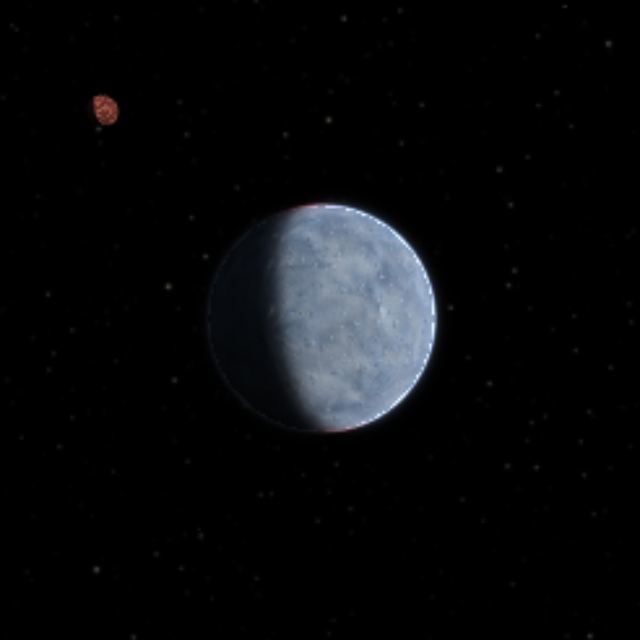
Icey
- Mass
- 4.10 × Earth
- Radius
- 1.60 × Earth
- Gravity
- 1.60 g
- Surface
- 55 K
- Year
- 164 years
- Day
- 58.0 hrs
- Mass
- 4.10 × Earth
- Radius
- 1.60 × Earth
- Gravity
- 1.60 g
- Surface
- 55 K
- Year
- 164 years
- Day
- 58.0 hrs
Icey's star
G-type · Yellow (Sun-like)
Icey30.00 AUIce WorldYou are hereHabitable zone
Star and planet drawn to scale (a typical star of its class), with only the star's edge in view. Orbits spaced as in the star system view.
Icey's moons
1 moon
Moon 1Nitrogen ice · 731,800 km
Planet, moons and orbits drawn to one scale; the smallest moons are enlarged so they can be seen.
The planet with the most number ice i guess it's made of a nice terrain
It has a moon named icey I
Surface. Frozen surface covered in water ice, possible subsurface ocean if tidal heating present
Ice World
Magnetic FieldLow Activity
Ice worlds form beyond the frost line where temperatures are low enough for water and other volatiles to freeze solid. They may have subsurface oceans beneath thick ice shells.
Classification Criteria:
✓ Distance: 30.00 AU (>3 AU) or Temperature <200K✓ Temperature: 55K✓ Water content: 44.1% for ice formation
Habitability ScoreUninhabitable
Contributing Factors
water22
Abundant water - frozen solid, no liquid phase at this temperature
geology60
Some geological activity provides slow nutrient cycling
rotation65
Slow rotation - significant day/night temperature variations, but life can adapt
Organic Chemistry80
Core organic elements (CHNO) present
atmosphere70
Thin nitrogen and methane atmosphere
Nitrogen atmosphere provides protection but not breathabletemperature10
Frozen world - minimal potential for complex life
magnetic Field100
Magnetic field provides radiation protection
Physical Properties
Mass
4.10x Earth (2.45e+25 kg)Radius
1.60x Earth (10,197 km)Surface Gravity
1.60x Earth (15.7 m/s²)Surface Temperature
55 K (-219 °C / -361 °F)Rotation Period
58.0 hours/day (slower than Earth)Elemental Composition
Closest Real Exoplanet
HD 40307 e72% similar
Orbiting HD 40307| Yours | HD 40307 e | |
|---|---|---|
| Mass | 4.10 × Earth | 3.50 × Earth |
| Radius | 1.96 × Earth | 1.69 × Earth |
| Density (composition) | 3.00 g/cm³ | 4.00 g/cm³ |
| Temperature | 54.6 K | — |
| Starlight received | 0.00 × Earth | — |
| Star temperature | 5,600 K | 4,977 K |
Moons
Moon 1recedingNitrogen & methane ice
Outside the synchronous orbit: slowly receding, like Luna (~cm per year).
Cold enough for nitrogen and methane to lie as frost on the surface (Triton-like).