Entering orbit…
AI assistant
Habitability
98/ 100
View planet
View star system
View surface
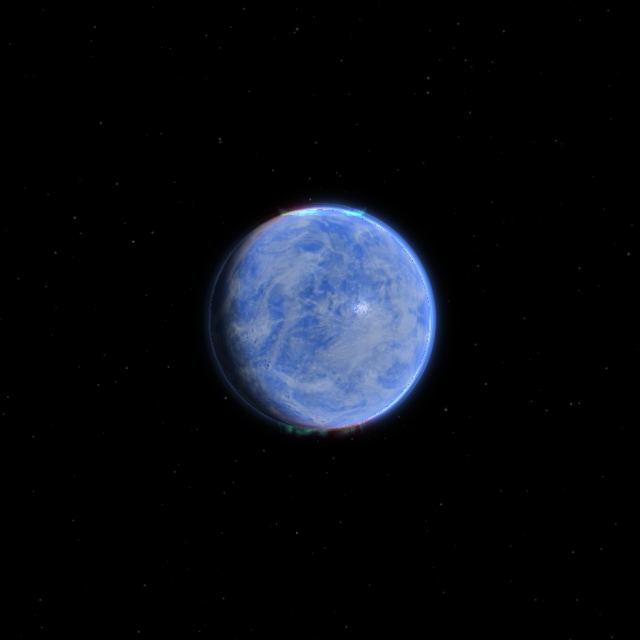
Water World with Life
- Mass
- 5.00 × Earth
- Radius
- 1.71 × Earth
- Gravity
- 1.71 g
- Surface
- 299 K
- Year
- 344 days
- Day
- 20.0 hrs
- Mass
- 5.00 × Earth
- Radius
- 1.71 × Earth
- Gravity
- 1.71 g
- Surface
- 299 K
- Year
- 344 days
- Day
- 20.0 hrs
Water World with Life's moons
1 moon
Moon 1Ice · 644,500 km
Planet, moons and orbits drawn to one scale; the smallest moons are enlarged so they can be seen.
Surface. Vast oceans covering most of the surface, scattered islands or archipelagos
✓ Conditions could support life. This planet’s modelled conditions could support biological processes: stable temperatures, liquid water and the chemistry life as we know it needs. That makes life possible, not present.
Water-Rich
✦ G star
Your planet has abundant oxygen (30.8%) and hydrogen (23.1%), creating extensive water coverage while in the habitable temperature zone.Life possibleMagnetic FieldHigh Activity
Water worlds have deep global oceans covering most or all of their surface. They form when planets have high water content and orbit in the habitable zone.
Classification Criteria:
✓ Oxygen: 30.8% + Hydrogen: 23.1% (water-forming elements)✓ Temperature: 299K (habitable range)✓ Distance: 0.96 AU (habitable zone)
Habitability ScoreHighly Habitable
Contributing Factors
water100
Abundant water
geology90
Active geology recycles nutrients and drives carbon cycle
rotation100
Optimal rotation period - balanced day/night cycle, moderate weather, and good heat distribution
Organic Chemistry100
All CHNOPS elements present - building blocks of life
atmosphere100
Nitrogen and oxygen with water vapor, mild greenhouse effect
Nitrogen-oxygen atmosphere - breathable and protectivetemperature100
Optimal temperature range for liquid water and life (large moon stabilizes the axial tilt - steady seasons)
magnetic Field100
Magnetic field provides radiation protection
Physical Properties
Mass
5.00x Earth (2.99e+25 kg)Radius
1.71x Earth (10,894 km)Surface Gravity
1.71x Earth (16.8 m/s²)Surface Temperature
299 K (26 °C / 79 °F)Rotation Period
20.0 hours/day (faster than Earth)Elemental Composition
Closest Real Exoplanet
Kepler-1606 b95% similar
Orbiting Kepler-1606| Yours | Kepler-1606 b | |
|---|---|---|
| Mass | 5.00 × Earth | 4.94 × Earth |
| Radius | 2.09 × Earth | 2.07 × Earth |
| Density (composition) | 3.00 g/cm³ | 3.07 g/cm³ |
| Temperature | 299.4 K | 324.0 K |
| Starlight received | 1.09 × Earth | 1.29 × Earth |
| Star temperature | 5,600 K | 5,422 K |
Moons
Moon 1receding
Outside the synchronous orbit: slowly receding, like Luna (~cm per year).
+5 temperature: large moon stabilizes the axial tilt - steady seasons