Entering orbit…
AI assistant
Habitability
14/ 100
View planet
View star system
View surface
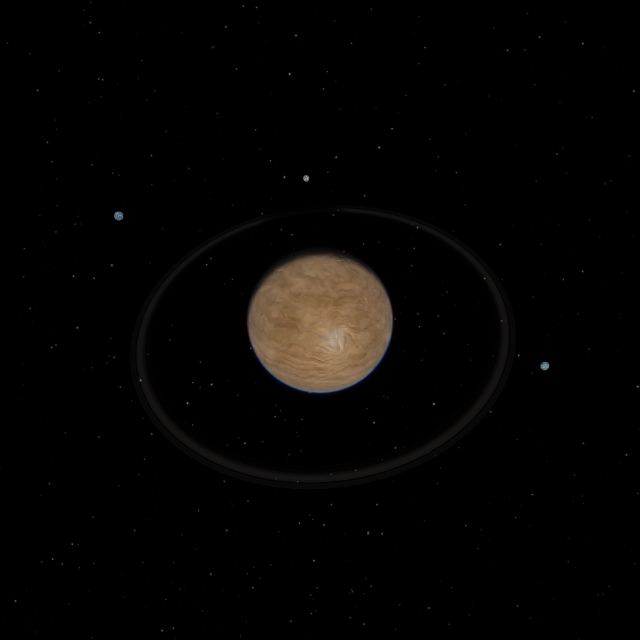
gran
- Mass
- 10.10 × Earth
- Radius
- 2.16 × Earth
- Gravity
- 2.16 g
- Surface
- 126 K
- Year
- 11.2 years
- Day
- 10.0 hrs
- Mass
- 10.10 × Earth
- Radius
- 2.16 × Earth
- Gravity
- 2.16 g
- Surface
- 126 K
- Year
- 11.2 years
- Day
- 10.0 hrs
gran's star
G-type · Yellow (Sun-like)
gran5.00 AUGas GiantYou are hereHabitable zone
Star and planet drawn to scale (a typical star of its class), with only the star's edge in view. Orbits spaced as in the star system view.
gran's moons
3 moons
Moon 2Ice · 214,900 km
Moon 3Ocean · 71,100 km
Moon 7Ice · 122,600 km
Planet, moons and orbits drawn to one scale; the smallest moons are enlarged so they can be seen.
Hydrogen and helium dominated with trace methane and ammonia.No solid surface - thick gaseous envelope with possible rocky core deep within.Closest Real Exoplanet
GJ 229 b
82% similar
Surface. No solid surface - thick gaseous envelope with possible rocky core deep within
Gas Giant
Magnetic FieldExtreme Activity
Gas giants form when massive cores capture enormous atmospheres of light gases. They typically form beyond the 'frost line' where volatiles can condense.
Classification Criteria:
✓ Hydrogen + Helium: 86.1% (>60% required)✓ Mass: 10.1x Earth (>10x required)
Habitability ScoreUninhabitable
Contributing Factors
water15
No solid surface — any water is locked in a supercritical mantle and hot ice, not oceans
geology60
Extreme volcanic activity may be hazardous (tidal flexing sustains geologic activity) (impact-resurfaced crust)
rotation10
Near tidally locked - one hemisphere perpetually scorched, other frozen, narrow habitable twilight zone only
Organic Chemistry84
Core organic elements (CHNO) present (tidal pools cycle wet and dry - a boost for prebiotic chemistry)
atmosphere10
Hydrogen and helium dominated with trace methane and ammonia
Hydrogen-rich atmosphere typical of gas giants (partially stripped by slow rotation) (atmosphere partially stripped by the moon impact)temperature20
Very cold - water frozen, challenging for life
magnetic Field100
Magnetic field provides radiation protection
Physical Properties
Mass
10.10x Earth (6.03e+25 kg)Radius
2.16x Earth (13,772 km)Surface Gravity
2.16x Earth (21.2 m/s²)Surface Temperature
126 K (-147 °C / -233 °F)Rotation Period
10.0 hours/day (faster than Earth)Elemental Composition
Closest Real Exoplanet
GJ 229 b82% similar
Orbiting GJ 229| Yours | GJ 229 b | |
|---|---|---|
| Mass | 10.1 × Earth | 14.9 × Earth |
| Radius | 3.50 × Earth | 3.97 × Earth |
| Density (composition) | 1.30 g/cm³ | 1.31 g/cm³ |
| Temperature | 125.8 K | 112.0 K |
| Starlight received | 0.04 × Earth | 0.02 × Earth |
| Star temperature | 5,600 K | 3,564 K |
Moons
Moon 1rings
Inside the Roche limit (1.79 planet radii): torn apart into a ring system.
Moon 2stableWater ice
Small and distant: a quiet, stable companion.
Tidal braking locked the planet to its moon: one face forever moonward.
Moon 3stableOcean world
Small and distant: a quiet, stable companion.
A thin tidal-warmed subsurface ocean may exist, but conditions are marginal (27/100).
Moon 4rings
Inside the synchronous orbit: it spiraled inward and was torn apart at the Roche limit (Phobos's fate).
Moon 5crashed
Inside the synchronous orbit: tidal decay dragged it down - it struck the planet ages ago.
Moon 6merged
Merged with an adjacent moon: too close for both to hold a stable orbit.
Moon 7stable
Small and distant: a quiet, stable companion.
Moon 8merged
Merged with an adjacent moon: too close for both to hold a stable orbit.
Moon 9merged
Merged with an adjacent moon: too close for both to hold a stable orbit.
Moon 10merged
Merged with an adjacent moon: too close for both to hold a stable orbit.
Moon 11rings
Inside the Roche limit (1.79 planet radii): torn apart into a ring system.
Moon 12merged
Merged with an adjacent moon: too close for both to hold a stable orbit.
+10 geology: tidal flexing sustains geologic activity+4 chemistry: tidal pools cycle wet and dry - a boost for prebiotic chemistry-2 atmosphere: atmosphere partially stripped by the moon impact+10 geology: impact-resurfaced crust