Entering orbit…
AI assistant
Habitability
5/ 100
View planet
View star system
View surface
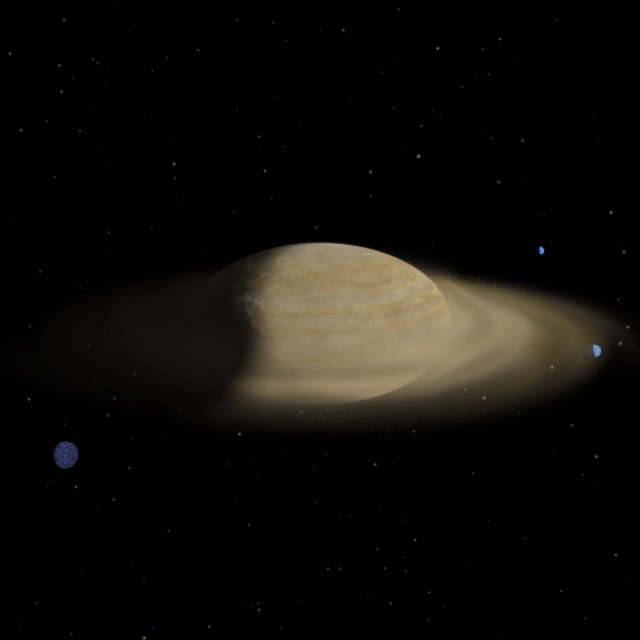
Polaris b
- Mass
- 14.00 × Earth
- Radius
- 2.41 × Earth
- Gravity
- 2.41 g
- Surface
- 266 K
- Year
- 363 years
- Day
- 3.0 hrs
- Mass
- 14.00 × Earth
- Radius
- 2.41 × Earth
- Gravity
- 2.41 g
- Surface
- 266 K
- Year
- 363 years
- Day
- 3.0 hrs
Polaris b's star
B-type · Blue Giant
Polaris b109.60 AUIce GiantYou are hereHabitable zone
Star and planet drawn to scale (a typical star of its class), with only the star's edge in view. Orbits spaced as in the star system view.
Polaris b's moons
3 moons
Moon 1Ocean · 41,800 km
Moon 2Rock · 147,300 km
Moon 3Ice · 1,405,500 km
Planet, moons and orbits drawn to one scale; the smallest moons are enlarged so they can be seen.
This is the only world in it’s system
(Please make this an actual system in a galaxy)
Surface. No solid surface - a deep volatile envelope over a supercritical water mantle and hot-ice interior
Ice Giant
Magnetic FieldExtreme Activity
Ice giants like Uranus and Neptune have icy interiors with thick atmospheres of hydrogen and helium, but not enough to be classified as gas giants.
Classification Criteria:
✓ Mass: 14.0x Earth (5-20x range)✓ Water/Carbon/Nitrogen rich composition
Habitability ScoreUninhabitable
Contributing Factors
water15
No solid surface — any water is locked in a supercritical mantle and hot ice, not oceans
geology50
Extreme volcanic activity may be hazardous (tidal flexing sustains geologic activity)
rotation10
Near tidally locked - one hemisphere perpetually scorched, other frozen, narrow habitable twilight zone only (Breaking apart: spinning faster than its own gravity can hold it together)
Organic Chemistry20
Limited organic chemistry potential
atmosphere12
Hydrogen and helium with water, methane, and ammonia ices
Hydrogen-rich atmosphere typical of gas giants (partially stripped by slow rotation)temperature70
Challenging but potentially habitable temperature
magnetic Field100
Magnetic field provides radiation protection
Physical Properties
Mass
14.00x Earth (8.36e+25 kg)Radius
2.41x Earth (15,355 km)Surface Gravity
2.41x Earth (23.6 m/s²)Surface Temperature
266 K (-8 °C / 18 °F)Rotation Period
3.0 hours/day (faster than Earth)Elemental Composition
Closest Real Exoplanet
HD 191939 g76% similar
Orbiting HD 191939| Yours | HD 191939 g | |
|---|---|---|
| Mass | 14.0 × Earth | 13.5 × Earth |
| Radius | 3.64 × Earth | 3.74 × Earth |
| Density (composition) | 1.60 g/cm³ | 1.42 g/cm³ |
| Temperature | 265.5 K | 278.0 K |
| Starlight received | 0.83 × Earth | 0.99 × Earth |
| Star temperature | 20,000 K | 5,348 K |
Moons
Moon 1stableOcean world
Small and distant: a quiet, stable companion.
Tidal braking locked the planet to its moon: one face forever moonward.
A thin tidal-warmed subsurface ocean may exist, but conditions are marginal (10/100).
Moon 2stableIce lost: bare rock
Small and distant: a quiet, stable companion.
Too warm for nitrogen and methane frost and too small to hold them as an atmosphere: those ices escaped to space, leaving water ice.
Too warm for ice and too small to hold an atmosphere: the ice sublimated, leaving bare rock.
Moon 3stable
Small and distant: a quiet, stable companion.
+10 geology: tidal flexing sustains geologic activity