Entering orbit…
AI assistant
Habitability
54/ 100
View planet
View star system
View surface
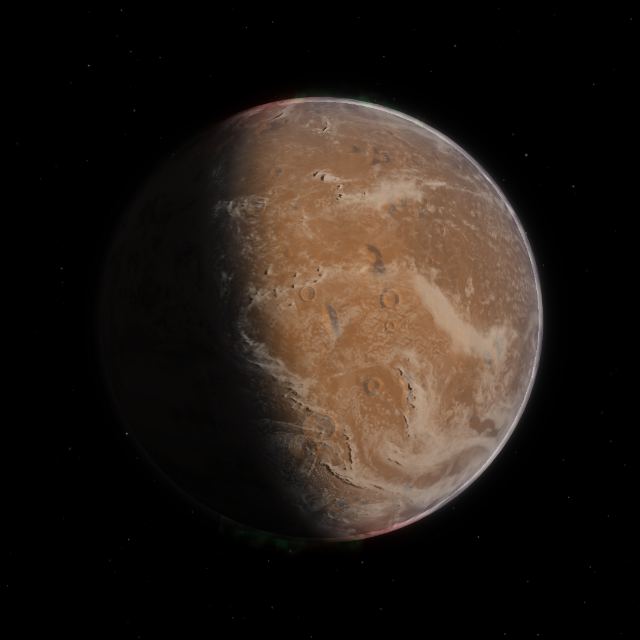
Errides
0
The only planet that orbits close to both stars with an atmosphere, as well as the only planet in the system with marginal conditions for life
Rocky Terrestrial
No life — no phosphorus — DNA and ATP are built on itMagnetic FieldLow Activity
Why is this a Rocky Terrestrial?Your planet is dominated by silicate (51.7%) and iron (3.9%) content, forming a rocky terrestrial body.
Rocky terrestrial planets are primarily composed of silicate rocks and metals. They're the most common type of small planet in the universe.
Classification Criteria:
✓ Silicon: 51.7% + Iron: 3.9% + Magnesium: 3.9%✓ Mass: 0.6x Earth (terrestrial range)
Habitability ScoreMarginal
Contributing Factors
water45
Limited water content (low gravity lets water escape to space)
geology60
Some geological activity provides slow nutrient cycling
rotation65
Slow rotation - significant day/night temperature variations, but life can adapt
Organic Chemistry50
Carbon and hydrogen present - organic chemistry possible
atmosphere50
CO₂ atmosphere with moderate greenhouse effect
temperature70
Challenging but potentially habitable temperature
magnetic Field100
Magnetic field provides radiation protection
Physical Properties
Mass
0.60x Earth (3.58e+24 kg)Radius
0.84x Earth (5,374 km)Surface Gravity
0.84x Earth (8.3 m/s²)Surface Temperature
342 K (69 °C / 156 °F)Rotation Period
56.0 hours/day (slower than Earth)Orbital Environment
Star Type
M-type (Red Dwarf)Distance from Star
0.14 AU (20.9 million km)Orbital Period
35 daysAtmosphere
Thin CO₂ atmosphere
Elemental Composition
Si - Silicon
51.7%
H - Hydrogen
23.4%
C - Carbon
7.3%
Surface Characteristics
Rocky surface with impact craters, possible volcanic featuresClosest Real Exoplanet
Kepler-138 e88% similar
Orbiting Kepler-138| Yours | Kepler-138 e | |
|---|---|---|
| Mass | 0.60 × Earth | 0.43 × Earth |
| Radius | 0.88 × Earth | 0.80 × Earth |
| Density (composition) | 4.81 g/cm³ | 4.68 g/cm³ |
| Temperature | 342.3 K | 292.0 K |
| Starlight received | 2.04 × Earth | 1.73 × Earth |
| Star temperature | 3,050 K | 3,841 K |