Entering orbit…
AI assistant
Habitability
75/ 100
View planet
View star system
View surface
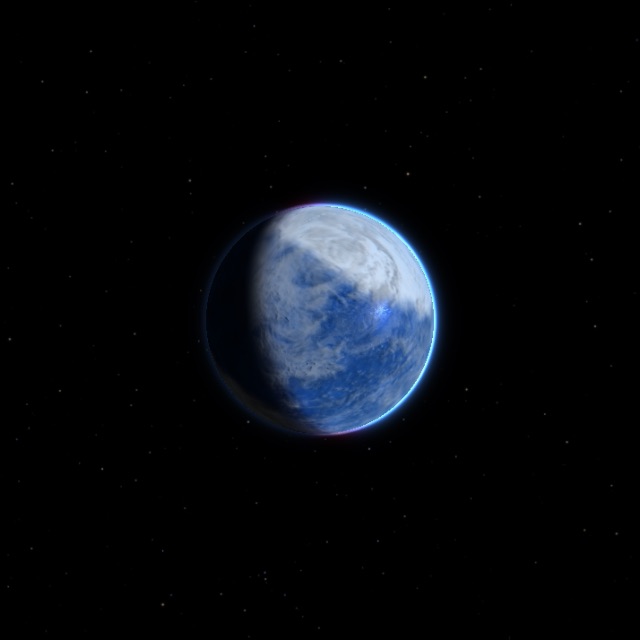
Aquaritus
0
Water World
✦ exo systemNo life — no phosphorus — DNA and ATP are built on itMagnetic FieldLow Activity
Why is this a Water World?Your planet has abundant oxygen (30.4%) and hydrogen (44.8%), creating extensive water coverage while in the habitable temperature zone.
Water worlds have deep global oceans covering most or all of their surface. They form when planets have high water content and orbit in the habitable zone.
Classification Criteria:
✓ Oxygen: 30.4% + Hydrogen: 44.8% (water-forming elements)✓ Temperature: 254K (habitable range)✓ Distance: 404.90 AU (habitable zone)
Habitability ScoreHabitable
Contributing Factors
water84
Abundant water - mostly frozen (low gravity lets water escape to space)
geology60
Some geological activity provides slow nutrient cycling
rotation60
Fast rotation - strong global wind patterns and weather systems, but manageable
Organic Chemistry55
Core organic elements (CHNO) present - chlorine-laced environment attacks organic molecules
atmosphere100
Nitrogen-oxygen atmosphere - breathable and protective
temperature70
Challenging but potentially habitable temperature
magnetic Field100
Magnetic field provides radiation protection
Physical Properties
Mass
0.70x Earth (4.18e+24 kg)Radius
0.89x Earth (5,657 km)Surface Gravity
0.89x Earth (8.7 m/s²)Surface Temperature
254 K (-19 °C / -2 °F)Rotation Period
12.0 hours/day (faster than Earth)Orbital Environment
Star Type
O-type (Blue Supergiant)Distance from Star
404.90 AU (60.6 billion km)Orbital Period
1,488 yearsAtmosphere
Nitrogen and oxygen with water vapor, mild greenhouse effect
Elemental Composition
H - Hydrogen
44.8%
O - Oxygen
30.4%
Cl - Chlorine
7.3%
Surface Characteristics
Vast oceans covering most of the surface, scattered islands or archipelagosClosest Real Exoplanet
TOI-700 e59% similar
Orbiting TOI-700| Yours | TOI-700 e | |
|---|---|---|
| Mass | 0.70 × Earth | 0.72 × Earth |
| Radius | 1.09 × Earth | 0.92 × Earth |
| Density (composition) | 3.00 g/cm³ | 5.10 g/cm³ |
| Temperature | 254.1 K | 273.0 K |
| Starlight received | 0.61 × Earth | 1.27 × Earth |
| Star temperature | 35,000 K | 3,459 K |
Moons
Moon 1stableSulfur-rich0.0040% - 17.8 radii
Small and distant: a quiet, stable companion.
Moon 2stableCarbon-rich0.0014% - 15.3 radii
Small and distant: a quiet, stable companion.