Entering orbit…
AI assistant
Habitability
17/ 100
View planet
View star system
View surface
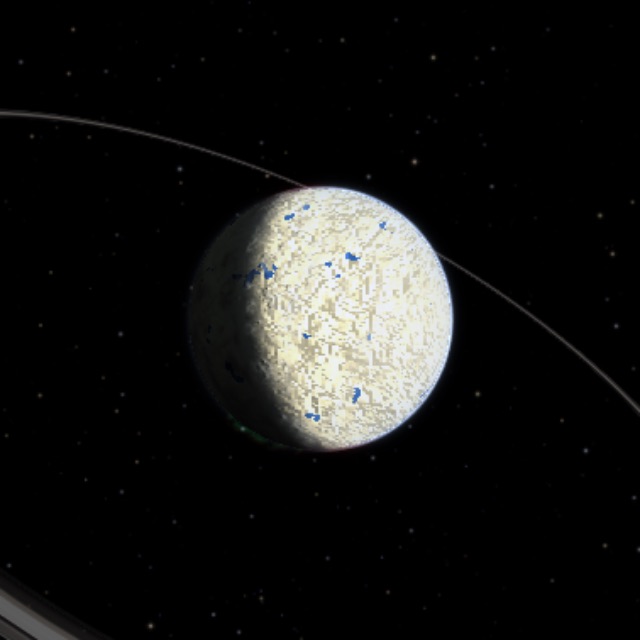
Uraniumases Coros
0
Exotic Terrestrial
✦ AgroLife possibleMagnetic FieldHigh Activity
Why is this a Exotic Terrestrial?
Your planet builds its crust from exotic minerals (29.5% calcium/titanium/aluminum-family rock formers) instead of the silicate-iron recipe every standard rocky world uses.Exotic terrestrials are temperate solid worlds whose geology skipped the silicate playbook - carbonate plains, titanium-gray mesas, alkali flats. They can hold air, water ingredients, and real habitability, but with no silicate continents or iron core they are their own class, not earth-likes.
Classification Criteria:
✓ Exotic rock formers: 29.5% (>=12% Ca/Ti/Al/K/Ni/U)✓ Standard rock: 4.3% (<15% - silicate rules never claimed it)✓ Temperature: 332K (240-380K temperate band)✓ Air + water ingredients: 39.6% O+H (>=15%) with an atmosphere
Habitability ScoreUninhabitable
Contributing Factors
water78
Abundant water (low gravity lets water escape to space)
geology90
Active geology recycles nutrients and drives carbon cycle
rotation30
Very slow rotation - extreme temperature swings between eternal day and night sides
Organic Chemistry100
All CHNOPS elements present - building blocks of life (tidal pools cycle wet and dry - a boost for prebiotic chemistry) — but the ground itself is radioactive, and no magnetic field shields a world from its own crust
atmosphere40
Atmosphere present but composition not ideal for life
temperature70
Challenging but potentially habitable temperature
magnetic Field100
Magnetic field provides radiation protection
Physical Properties
Mass
0.50x Earth (2.99e+24 kg)Radius
0.79x Earth (5,057 km)Surface Gravity
0.79x Earth (7.8 m/s²)Surface Temperature
332 K (59 °C / 138 °F)Rotation Period
16.0 hours/day (faster than Earth)Orbital Environment
Star Type
G-type (Yellow (Sun-like))Distance from Star
0.70 AU (105 million km)Orbital Period
214 daysAtmosphere
Thin trace-gas atmosphere
Elemental Composition
U - Uranium
29.0%
O - Oxygen
22.2%
S - Sulfur
21.7%
Surface Characteristics
Pale mineral plains — carbonate flats, chalk mesas, and crusts no silicate world can buildClosest Real Exoplanet
Kepler-138 e89% similar
Orbiting Kepler-138| Yours | Kepler-138 e | |
|---|---|---|
| Mass | 0.50 × Earth | 0.43 × Earth |
| Radius | 0.88 × Earth | 0.80 × Earth |
| Density (composition) | 4.03 g/cm³ | 4.68 g/cm³ |
| Temperature | 332.3 K | 292.0 K |
| Starlight received | 2.04 × Earth | 1.73 × Earth |
| Star temperature | 5,600 K | 3,841 K |
Moons
Moon 1rings0.014% - 1.2 radii
Inside the Roche limit (2.80 planet radii): torn apart into a ring system.
Moon 2rings0.00032% - 3.6 radii
Inside the synchronous orbit: it spiraled inward and was torn apart at the Roche limit (Phobos's fate).
Moon 3stable0.025% - 12.6 radii
Small and distant: a quiet, stable companion.
Moon 4merged0.56% - 1.2 radii
Merged with an adjacent moon: too close for both to hold a stable orbit.
Habitability
✓ Conditions could support lifeThis planet’s modelled conditions could support biological processes: stable temperatures, liquid water and the chemistry life as we know it needs. That makes life possible, not present.Love TerraForge? Please help support us.Keeps it ad-free, and funds new features and hosting.