Entering orbit…
AI assistant
Habitability
0/ 100
View planet
View star system
View surface
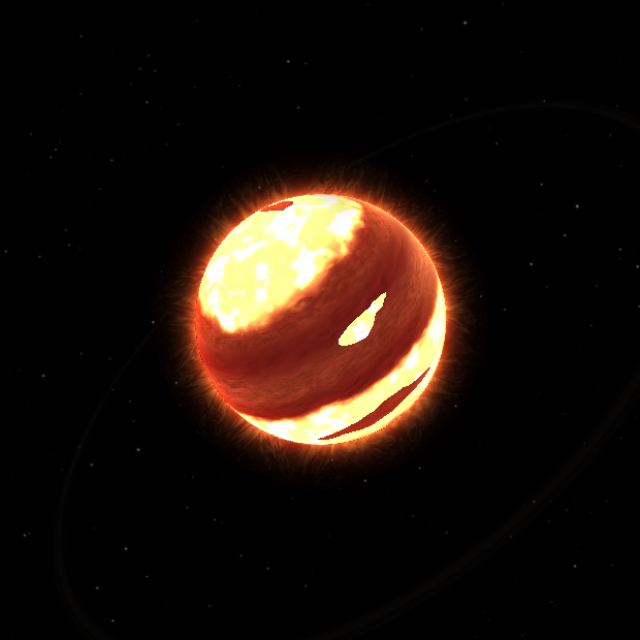
Wasden binary system
0
Planet is ssooooo dangerous!
Brown Dwarf
✦ NatanMagnetic FieldNone Activity
Why is this a Brown Dwarf?Your planet has an unusual composition that doesn't fit standard classifications, or lacks the elements needed for complex geological processes.
Barren worlds can form from uncommon element combinations or may be remnants of larger bodies that lost their atmospheres and volatile materials.
Classification Criteria:
Composition doesn't match standard planet typesMass: 9534.0x EarthTemperature: 2200K
Habitability ScoreUninhabitable
Contributing Factors
water15
No solid surface — any water is locked in a supercritical mantle and hot ice, not oceans
geology30
Geologically dead - no nutrient recycling
rotation65
Slow rotation - significant day/night temperature variations, but life can adapt
Organic Chemistry25
Carbon and hydrogen present - organic chemistry possible - chlorine-laced environment attacks organic molecules
atmosphere30
Hydrogen-rich atmosphere typical of gas giants
temperature0
Inferno world - temperatures exceed all possibility of life (strong seasons from a 132° tilt: −3% habitability)
magnetic Field20
A strong field, but no surface beneath it — there is nothing here for it to shelter
Physical Properties
Mass
9534.00x Earth (5.69e+28 kg)Radius
21.20x Earth (135,093 km)Surface Gravity
21.20x Earth (208.0 m/s²)Surface Temperature
2,200 K (1,927 °C / 3,500 °F)Rotation Period
60.0 hours/day (slower than Earth)Orbital Environment
Star Type
BH-type (Black Hole)Distance from Star
1.00 AU (150 million km)Orbital Period
116 daysAtmosphere
Hydrogen and helium with iron and silicate cloud decks - hot enough to rain molten metal
Elemental Composition
H - Hydrogen
66.2%
Cl - Chlorine
17.3%
C - Carbon
16.5%
Surface Characteristics
No surface: a deuterium-burning sphere the size of Jupiter and dozens of times its mass, glowing dull red from its own heatClosest Real Exoplanet
TYC 8998-760-1 b78% similar
Orbiting TYC 8998-760-1| Yours | TYC 8998-760-1 b | |
|---|---|---|
| Mass | 9,534 × Earth | 6,930 × Earth |
| Radius | 21.2 × Earth | 21.2 × Earth |
| Density (composition) | — | 4.01 g/cm³ |
| Temperature | 2,200 K | 2,638 K |
| Starlight received | 400.0 × Earth | — |
| Star temperature | — | 4,573 K |
Moons
Moon 1rings0.010% - 2.8 radii
Inside the synchronous orbit: it spiraled inward and was torn apart at the Roche limit (Phobos's fate).