Entering orbit…
AI assistant
Habitability
50/ 100
View planet
View star system
View surface
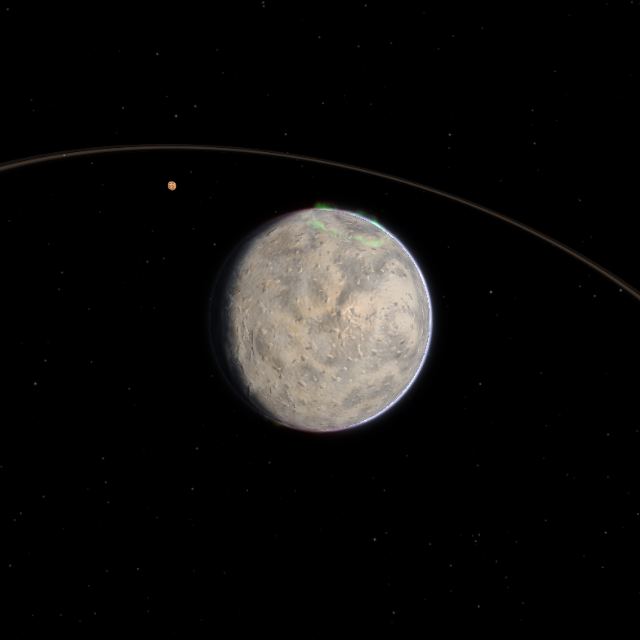
Koruun
0
Ice World
✦ ThyrelNo life — too cold for liquid waterMagnetic FieldLow Activity
Why is this a Ice World?Your planet orbits at 0.93 AU from its star, resulting in frigid temperatures of 233K.
Ice worlds form beyond the frost line where temperatures are low enough for water and other volatiles to freeze solid. They may have subsurface oceans beneath thick ice shells.
Classification Criteria:
✓ Distance: 0.93 AU (>3 AU) or Temperature <200K✓ Temperature: 233K✓ Water content: 30.2% for ice formation
Habitability ScoreMarginal
Contributing Factors
water60
Good water content - mostly frozen
geology60
Some geological activity provides slow nutrient cycling
rotation30
Very slow rotation - severe temperature swings between eternal day and night sides
Organic Chemistry100
All CHNOPS elements present - building blocks of life (tidal pools cycle wet and dry - a boost for prebiotic chemistry)
atmosphere42
Nitrogen atmosphere provides protection but not breathable (partially stripped by slow rotation)
temperature40
Extreme temperature - very difficult for life
magnetic Field100
Magnetic field provides radiation protection
Physical Properties
Mass
2.20x Earth (1.31e+25 kg)Radius
1.30x Earth (8,286 km)Surface Gravity
1.30x Earth (12.8 m/s²)Surface Temperature
233 K (-41 °C / -41 °F)Rotation Period
20.0 hours/day (faster than Earth)Orbital Environment
Star Type
K-type (Orange)Distance from Star
0.93 AU (139 million km)Orbital Period
1.07 yearsAtmosphere
Thin nitrogen and methane atmosphere
Elemental Composition
O - Oxygen
25.0%
Si - Silicon
22.9%
Fe - Iron
16.7%
Surface Characteristics
Frozen surface covered in water ice, possible subsurface ocean if tidal heating presentClosest Real Exoplanet
Kepler-1229 b85% similar
Orbiting Kepler-1229| Yours | Kepler-1229 b | |
|---|---|---|
| Mass | 2.20 × Earth | 2.54 × Earth |
| Radius | 1.59 × Earth | 1.40 × Earth |
| Density (composition) | 3.00 g/cm³ | 5.10 g/cm³ |
| Temperature | 232.6 K | 212.0 K |
| Starlight received | 0.46 × Earth | 0.52 × Earth |
| Star temperature | 4,450 K | 3,784 K |
Moons
Moon 1rings0.010% - 2.8 radii
Inside the Roche limit (2.80 planet radii): torn apart into a ring system.
Moon 2rings0.010% - 4.3 radii
Inside the synchronous orbit: it spiraled inward and was torn apart at the Roche limit (Phobos's fate).
Moon 3stable0.010% - 7.5 radii
Small and distant: a quiet, stable companion.