Entering orbit…
AI assistant
Habitability
14/ 100
View planet
View star system
View surface
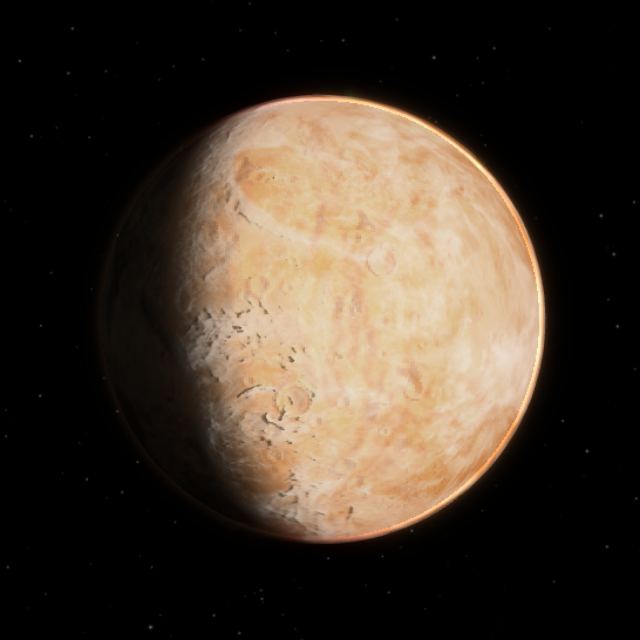
Muras
0
Desert World
✦ ValgaMagnetic FieldLow Activity
Why is this a Desert World?Your planet is a hot (483K), bone-dry silicate rock that kept its atmosphere - with no water cycle to wash the air, wind lofts a permanent dust veil over endless dune seas.
Desert worlds are the Tatooine/Arrakis archetype: enough rock to build a solid surface, enough air to carry dust, and too little hydrogen for oceans or rain. Heat bakes out any trace moisture, so nothing interrupts the wind's work - dune seas, wind-carved rock, scorching days.
Classification Criteria:
✓ Hydrogen: 2.6% (<5% - bone dry, no water cycle)✓ Temperature: 483K (300-500K hot band)✓ Silicon + Iron + Magnesium: 66.7% (>=30% - a real rocky surface)✓ Holds an atmosphere to carry the dust haze
Habitability ScoreUninhabitable
Contributing Factors
water12
Very dry - minimal water - likely as steam
geology60
Some geological activity provides slow nutrient cycling
rotation65
Slow rotation - significant day/night temperature variations, but life can adapt
Organic Chemistry50
Carbon and hydrogen present - organic chemistry possible
atmosphere70
Nitrogen atmosphere provides protection but not breathable
temperature15
Extremely hot - hostile to known life forms
magnetic Field100
Magnetic field provides radiation protection
Physical Properties
Mass
0.60x Earth (3.58e+24 kg)Radius
0.84x Earth (5,374 km)Surface Gravity
0.84x Earth (8.3 m/s²)Surface Temperature
483 K (209 °C / 409 °F)Rotation Period
71.0 hours/day (slower than Earth)Orbital Environment
Star Type
G-type (Yellow (Sun-like))Distance from Star
0.39 AU (58.3 million km)Orbital Period
89 daysAtmosphere
Thin, dusty CO₂-nitrogen atmosphere - permanent haze of wind-borne sand
Elemental Composition
Si - Silicon
35.9%
Fe - Iron
30.8%
C - Carbon
12.8%
Surface Characteristics
Endless dune seas and wind-carved rock under a permanent dust haze - scorching days, freezing nightsClosest Real Exoplanet
YZ Cet b87% similar
Orbiting YZ Cet| Yours | YZ Cet b | |
|---|---|---|
| Mass | 0.60 × Earth | 0.70 × Earth |
| Radius | 0.88 × Earth | 0.91 × Earth |
| Density (composition) | 4.81 g/cm³ | 5.07 g/cm³ |
| Temperature | 482.5 K | 471.0 K |
| Starlight received | 6.57 × Earth | 8.21 × Earth |
| Star temperature | 5,600 K | 3,151 K |