Entering orbit…
AI assistant
Habitabilityno longer habitable
View planet
View star system
View surface
Asteroid2
0
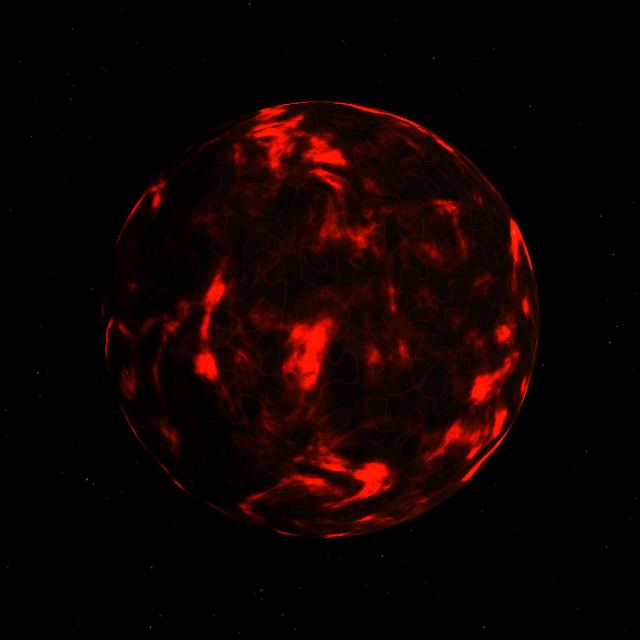
Lava World
✦ Tau SystemDestroyed — no longer habitableExtreme Activity
Why is this a Lava World?A moon inside the synchronous orbit spiraled in and struck the planet. The impact remelted the surface into a global magma ocean.
Tidal decay drags close-in moons down over millions of years. A large enough impactor liquefies the crust, strips atmosphere, and resets the surface - whatever the orbit's temperature would otherwise allow.
Classification Criteria:
✓ Moon inside the synchronous orbit (tidal decay)✓ Impactor massive enough to remelt the crust- Orbit itself was fine: 2.64 AU, 1400K equilibrium
Habitability
Destroyed — no longer habitablePhysical Properties
Mass
0.90x Earth (5.37e+24 kg)Radius
0.97x Earth (6,151 km)Surface Gravity
0.97x Earth (9.5 m/s²)Surface Temperature
1,400 K (1,127 °C / 2,060 °F)Rotation Period
2,000.0 hours/day (slower than Earth)Orbital Environment
Star Type
K-type (Orange)Distance from Star
2.64 AU (395 million km)Orbital Period
5.13 yearsAtmosphere
Vaporized rock and impact ash - the original atmosphere blown off by the strike
Elemental Composition
Si - Silicon
33.3%
O - Oxygen
20.0%
Fe - Iron
20.0%
Surface Characteristics
Surface remelted by a catastrophic moon impact - a global magma ocean cooling into scarred rockClosest Real Exoplanet
Teegarden's Star d51% similar
Orbiting Teegarden's Star| Yours | Teegarden's Star d | |
|---|---|---|
| Mass | 0.90 × Earth | 0.82 × Earth |
| Radius | 0.97 × Earth | 0.95 × Earth |
| Density (composition) | 5.39 g/cm³ | 5.20 g/cm³ |
| Temperature | 1,400 K | 159.0 K |
| Starlight received | 0.06 × Earth | 0.12 × Earth |
| Star temperature | 4,450 K | 3,034 K |