Entering orbit…
AI assistant
Habitability
0/ 100
View planet
View star system
View surface
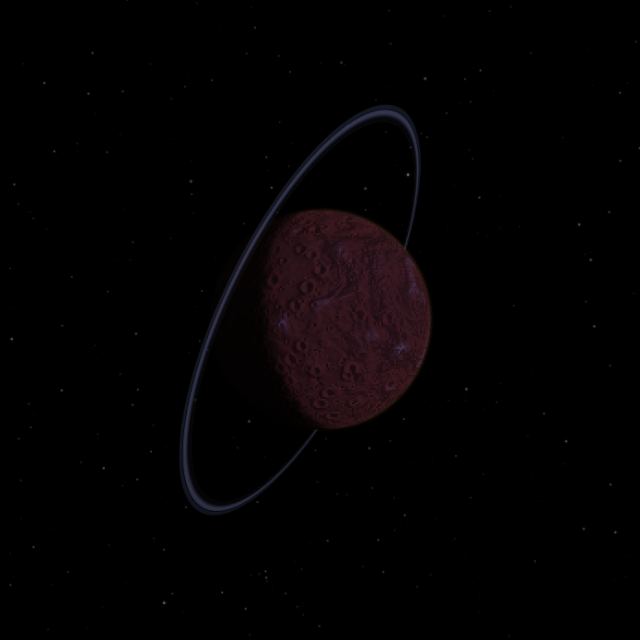
Riadiaat
0
Astrolabe System
Rocky Terrestrial
✦ Astrolabe SystemMagnetic FieldModerate Activity
Why is this a Rocky Terrestrial?Your planet is dominated by silicate (0.0%) and iron (33.3%) content, forming a rocky terrestrial body.
Rocky terrestrial planets are primarily composed of silicate rocks and metals. They're the most common type of small planet in the universe.
Classification Criteria:
✓ Silicon: 0.0% + Iron: 33.3% + Magnesium: 11.1%✓ Mass: 1.8x Earth (terrestrial range)
Habitability ScoreUninhabitable
Contributing Factors
water0
No water - the recipe has no hydrogen and oxygen to form it
geology90
Active geology recycles nutrients and drives carbon cycle
rotation100
Optimal rotation period - balanced day/night cycle, moderate weather, and good heat distribution
Organic Chemistry20
Limited organic chemistry potential
atmosphere40
Atmosphere present but composition not ideal for life
temperature100
Optimal temperature range for liquid water and life (extreme seasons: at 109° the poles swing between months-long day and night: −14% habitability)
magnetic Field100
Magnetic field provides radiation protection
Physical Properties
Mass
1.80x Earth (1.07e+25 kg)Radius
1.22x Earth (7,750 km)Surface Gravity
1.22x Earth (11.9 m/s²)Surface Temperature
289 K (16 °C / 60 °F)Rotation Period
24.0 hours/dayOrbital Environment
Star Type
B-type (Blue Giant)Distance from Star
92.60 AU (13.9 billion km)Orbital Period
281.8 yearsAtmosphere
Thin, dusty trace-gas atmosphere
Elemental Composition
P - Phosphorus
44.4%
Fe - Iron
33.3%
O - Oxygen
11.1%
Surface Characteristics
Rocky surface with impact craters, possible volcanic featuresClosest Real Exoplanet
Kepler-1512 b72% similar
Orbiting Kepler-1512| Yours | Kepler-1512 b | |
|---|---|---|
| Mass | 1.80 × Earth | 1.76 × Earth |
| Radius | 1.19 × Earth | 1.18 × Earth |
| Density (composition) | 5.93 g/cm³ | 5.90 g/cm³ |
| Temperature | 288.9 K | 322.0 K |
| Starlight received | 1.17 × Earth | 1.60 × Earth |
| Star temperature | 20,000 K | 4,372 K |
Moons
Moon 1rings0.00022% - 2.0 radii
Inside the Roche limit (2.80 planet radii): torn apart into a ring system.
Moon 2stable0.00056% - 9.8 radii
Small and distant: a quiet, stable companion.
Moon 3stable0.0010% - 13.1 radii
Small and distant: a quiet, stable companion.
Moon 4stable0.0016% - 7.5 radii
Small and distant: a quiet, stable companion.