Entering orbit…
AI assistant
Habitability
26/ 100
View planet
View star system
View surface
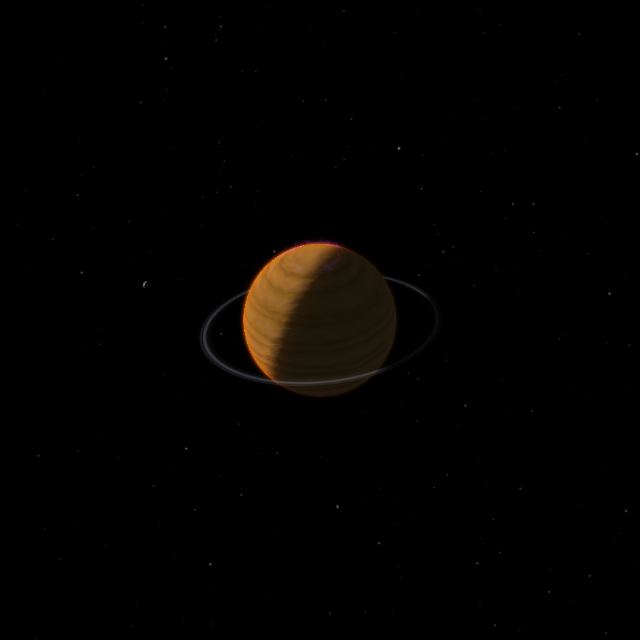
Takenium
0
Very close to its host star, but somehow received less gas from the protoplanetary disk during formation, which is believed to have been stolen from other planets nearby
Gas Dwarf
✦ TakuriusNo life — no phosphorus — DNA and ATP are built on itMagnetic FieldLow Activity
Why is this a Gas Dwarf?Your planet has an unusual composition that doesn't fit standard classifications, or lacks the elements needed for complex geological processes.
Barren worlds can form from uncommon element combinations or may be remnants of larger bodies that lost their atmospheres and volatile materials.
Classification Criteria:
Composition doesn't match standard planet typesMass: 74.0x EarthTemperature: 324K
Habitability ScoreExtremely Harsh
Contributing Factors
water15
No solid surface — any water is locked in a supercritical mantle and hot ice, not oceans
geology60
Some geological activity provides slow nutrient cycling
rotation10
Near tidally locked - one hemisphere perpetually scorched, other frozen, narrow habitable twilight zone only
Organic Chemistry84
Core organic elements (CHNO) present (tidal pools cycle wet and dry - a boost for prebiotic chemistry)
atmosphere12
Hydrogen-rich atmosphere typical of gas giants (partially stripped by slow rotation)
temperature70
Challenging but potentially habitable temperature
magnetic Field100
Magnetic field provides radiation protection
Physical Properties
Mass
74.00x Earth (4.42e+26 kg)Radius
4.20x Earth (26,748 km)Surface Gravity
4.20x Earth (41.2 m/s²)Surface Temperature
324 K (51 °C / 124 °F)Rotation Period
8.0 hours/day (faster than Earth)Orbital Environment
Star Type
F-type (White)Distance from Star
1.80 AU (269 million km)Orbital Period
2.12 yearsAtmosphere
Deep hydrogen-helium envelope with photochemical haze
Elemental Composition
H - Hydrogen
49.1%
Ar - Argon
23.4%
N - Nitrogen
7.0%
Surface Characteristics
No solid surface - a thick gas envelope wrapped around a small deep core (a mini-Neptune)Closest Real Exoplanet
TOI-2134 c80% similar
Orbiting TOI-2134| Yours | TOI-2134 c | |
|---|---|---|
| Mass | 74.0 × Earth | 58.3 × Earth |
| Radius | 6.34 × Earth | 7.35 × Earth |
| Density (composition) | 1.60 g/cm³ | 0.81 g/cm³ |
| Temperature | 324.3 K | 302.0 K |
| Starlight received | 1.85 × Earth | 1.40 × Earth |
| Star temperature | 6,750 K | 4,580 K |
Moons
Moon 1rings0.00063% - 1.6 radii
Inside the Roche limit (1.79 planet radii): torn apart into a ring system.
Moon 2stable0.013% - 5.5 radii
Small and distant: a quiet, stable companion.
Tidal braking locked the planet to its moon: one face forever moonward.