Entering orbit…
AI assistant
Habitability
22/ 100
View planet
View star system
View surface
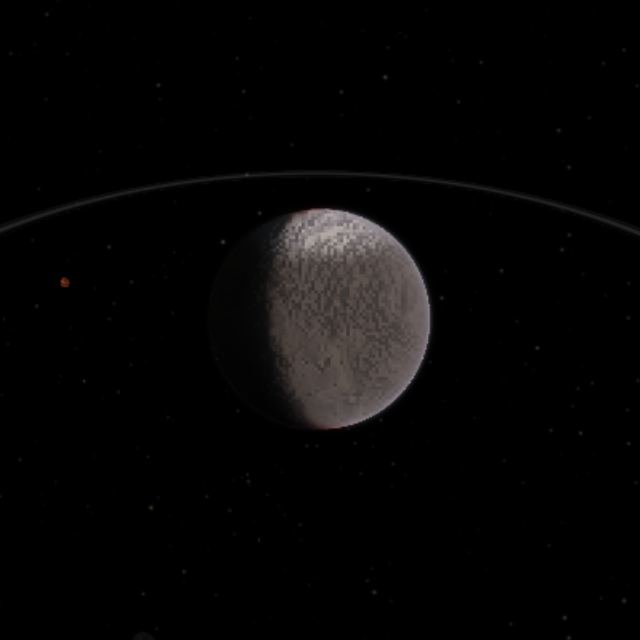
Caropano 922 b
- Mass
- 0.60 × Earth
- Radius
- 0.84 × Earth
- Gravity
- 0.84 g
- Surface
- 230 K
- Year
- 644 days
- Day
- 24.0 hrs
- Mass
- 0.60 × Earth
- Radius
- 0.84 × Earth
- Gravity
- 0.84 g
- Surface
- 230 K
- Year
- 644 days
- Day
- 24.0 hrs
Caropano 922 b's star
G-type · Yellow (Sun-like)
Caropano 922 b1.46 AUBarrenYou are hereHabitable zone
Star and planet drawn to scale (a typical star of its class), with only the star's edge in view. Orbits spaced as in the star system view.
Caropano 922 b's moons
3 moons
Moon 2Carbon · 44,200 km
Moon 4Rock · 36,200 km
Moon 5Volcanic · 64,300 km
Planet, moons and orbits drawn to one scale; the smallest moons are enlarged so they can be seen.
This world is quite strange,having a rocky terrain and sometimes grass. It was born in March 12,2008. It has 5 moons(technically,4. You'll see why) one of them spiraled into caropano 922 b and became rings. Mass is 0.6 x earth. It was discovered in june 2nd,2021.
Surface. Barren rocky surface with unusual elemental composition
Barren
Magnetic FieldLow Activity
Barren worlds can form from uncommon element combinations or may be remnants of larger bodies that lost their atmospheres and volatile materials.
Classification Criteria:
Composition doesn't match standard planet typesMass: 0.6x EarthTemperature: 230K
Habitability ScoreExtremely Harsh
Contributing Factors
water26
Limited water content - mostly frozen
geology60
Some geological activity provides slow nutrient cycling
rotation45
Near tidally locked - one hemisphere perpetually scorched, other frozen, narrow habitable twilight zone only
Organic Chemistry0
Limited organic chemistry potential - chlorine-laced environment attacks organic molecules
atmosphere40
Thin trace-gas atmosphere
Atmosphere present but composition not ideal for lifetemperature34
Extreme cold - very difficult for life
magnetic Field100
Magnetic field provides radiation protection
Physical Properties
Mass
0.60x Earth (3.58e+24 kg)Radius
0.84x Earth (5,374 km)Surface Gravity
0.84x Earth (8.3 m/s²)Surface Temperature
230 K (-43 °C / -46 °F)Rotation Period
24.0 hours/dayElemental Composition
Closest Real Exoplanet
TRAPPIST-1 e83% similar
Orbiting TRAPPIST-1| Yours | TRAPPIST-1 e | |
|---|---|---|
| Mass | 0.60 × Earth | 0.69 × Earth |
| Radius | 0.88 × Earth | 0.92 × Earth |
| Density (composition) | 4.81 g/cm³ | 4.90 g/cm³ |
| Temperature | 230.1 K | 250.0 K |
| Starlight received | 0.47 × Earth | 0.65 × Earth |
| Star temperature | 5,600 K | 2,566 K |
Moons
Moon 1rings
Inside the synchronous orbit: it spiraled inward and was torn apart at the Roche limit (Phobos's fate).
Moon 2recedingCarbon-rich
Outside the synchronous orbit: slowly receding, like Luna (~cm per year).
Tidal braking locked the planet to its moon: one face forever moonward.
Moon 3merged
Merged with an adjacent moon: too close for both to hold a stable orbit.
Moon 4stableSilicate rock
Small and distant: a quiet, stable companion.
Moon 5recedingVolcanic
Outside the synchronous orbit: slowly receding, like Luna (~cm per year).
Tidal flexing melts its interior: an actively volcanic surface (Io-like).
+4 chemistry: tidal pools cycle wet and dry - a boost for prebiotic chemistry