Entering orbit…
AI assistant
Habitability
0/ 100
View planet
View star system
View surface
enero
0
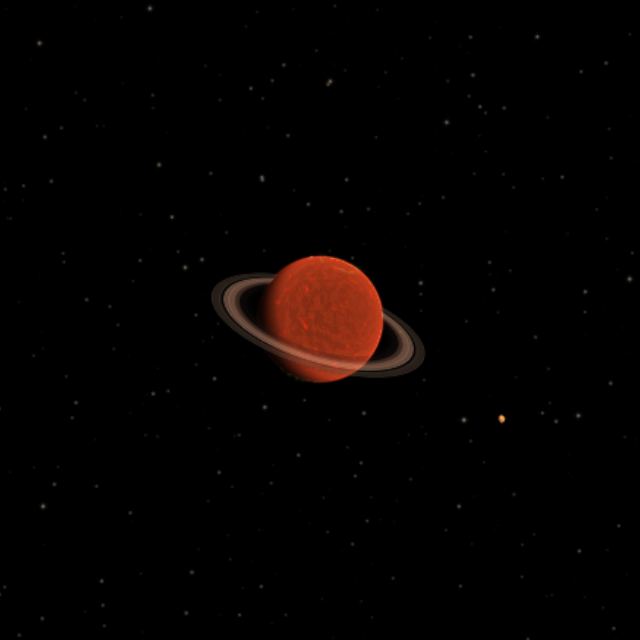
Lava World
No life — too hot for liquid waterMagnetic FieldExtreme Activity
Why is this a Lava World?A moon inside the synchronous orbit spiraled in and struck the planet. The impact remelted the surface into a global magma ocean.
Tidal decay drags close-in moons down over millions of years. A large enough impactor liquefies the crust, strips atmosphere, and resets the surface - whatever the orbit's temperature would otherwise allow.
Classification Criteria:
✓ Moon inside the synchronous orbit (tidal decay)✓ Impactor massive enough to remelt the crust- Orbit itself was fine: 0.12 AU, 1400K equilibrium
Habitability ScoreUninhabitable
Contributing Factors
water8
Limited water content - boiling away, little would be retained
geology50
Extreme volcanic activity may be hazardous (impact-resurfaced crust)
rotation10
Near tidally locked - one hemisphere perpetually scorched, other frozen, narrow habitable twilight zone only
Organic Chemistry84
Core organic elements (CHNO) present (tidal pools cycle wet and dry - a boost for prebiotic chemistry)
atmosphere14
Atmosphere present but composition not ideal for life (partially stripped by slow rotation) (atmosphere partially stripped by the moon impact)
temperature0
Inferno world - temperatures exceed all possibility of life
magnetic Field100
Magnetic field provides radiation protection
Physical Properties
Mass
1.00x Earth (5.97e+24 kg)Radius
1.00x Earth (6,371 km)Surface Gravity
1.00x Earth (9.8 m/s²)Surface Temperature
1,400 K (1,127 °C / 2,060 °F)Rotation Period
24.0 hours/dayOrbital Environment
Star Type
K-type (Orange)Distance from Star
0.12 AU (18 million km)Orbital Period
18 daysAtmosphere
Vaporized rock and impact ash - the original atmosphere blown off by the strike
Elemental Composition
O - Oxygen
30.4%
Si - Silicon
25.0%
N - Nitrogen
14.1%
Surface Characteristics
Surface remelted by a catastrophic moon impact - a global magma ocean cooling into scarred rockClosest Real Exoplanet
Kepler-399 b82% similar
Orbiting Kepler-399| Yours | Kepler-399 b | |
|---|---|---|
| Mass | 1.00 × Earth | 0.84 × Earth |
| Radius | 1.00 × Earth | 0.96 × Earth |
| Density (composition) | 5.50 g/cm³ | 5.23 g/cm³ |
| Temperature | 1,400 K | 773.0 K |
| Starlight received | 27.8 × Earth | 35.6 × Earth |
| Star temperature | 4,450 K | 5,502 K |
Moons
Moon 1rings0.18% - 1.8 radii
Inside the Roche limit (2.80 planet radii): torn apart into a ring system.
Moon 2crashed0.10% - 4.9 radii
Inside the synchronous orbit: tidal decay dragged it down - it struck the planet ages ago.
Moon 3stable0.010% - 6.9 radii
Small and distant: a quiet, stable companion.
Tidal braking locked the planet to its moon: one face forever moonward.
Moon 4merged0.010% - 7.3 radii
Merged with an adjacent moon: too close for both to hold a stable orbit.