Entering orbit…
AI assistant
Habitability
19/ 100
View planet
View star system
View surface
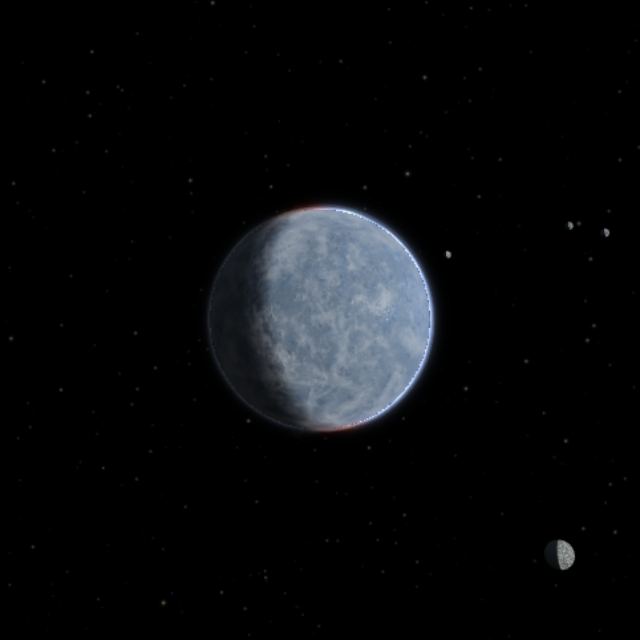
Icer
Ice World
- Mass
- 1.00 × Earth
- Radius
- 1.00 × Earth
- Gravity
- 1.00 g
- Surface
- 174 K
- Year
- 4.2 years
- Day
- 24.0 hrs
- Mass
- 1.00 × Earth
- Radius
- 1.00 × Earth
- Gravity
- 1.00 g
- Surface
- 174 K
- Year
- 4.2 years
- Day
- 24.0 hrs
Icer's star
G-type · Yellow (Sun-like)
Icer2.62 AUIce WorldYou are hereHabitable zone
Star and planet drawn to scale (a typical star of its class), with only the star's edge in view. Orbits spaced as in the star system view.
Icer's moons
10 moons
Moon 3Ice · 109,800 km
Moon 5Ice · 89,200 km
Moon 6Ice · 384,900 km
Moon 7Ice · 162,700 km
Moon 10Ice · 292,900 km
Moon 11Ice · 47,800 km
Moon 13Ice · 192,500 km
Moon 14Ice · 538,600 km
Moon 15Ice · 637,100 km
Moon 16Ice · 247,600 km
Planet, moons and orbits drawn to one scale; the smallest moons are enlarged so they can be seen.
16 moons! Noah Yuna Mlola Zrox Roxanne Sienna Wonat Botyo Kina Leo Mosa Rosea Filo Ryan Vrx Xavie
G-type star Tlos
Surface. Frozen surface covered in water ice, possible subsurface ocean if tidal heating present
Ice World
Life unlikely — too cold for liquid waterMagnetic FieldLow Activity
Ice worlds form beyond the frost line where temperatures are low enough for water and other volatiles to freeze solid. They may have subsurface oceans beneath thick ice shells.
Classification Criteria:
✓ Distance: 2.62 AU (>3 AU) or Temperature <200K✓ Temperature: 174K✓ Water content: 34.4% for ice formation
Habitability ScoreUninhabitable
Contributing Factors
water11
Limited water content - frozen solid, no liquid phase at this temperature
geology60
Some geological activity provides slow nutrient cycling
rotation100
Optimal rotation period - balanced day/night cycle, moderate weather, and good heat distribution
Organic Chemistry84
Core organic elements (CHNO) present (tidal pools cycle wet and dry - a boost for prebiotic chemistry)
atmosphere70
Thin nitrogen and methane atmosphere
Nitrogen atmosphere provides protection but not breathabletemperature20
Very cold - water frozen, challenging for life
magnetic Field100
Magnetic field provides radiation protection
Physical Properties
Mass
1.00x Earth (5.97e+24 kg)Radius
1.00x Earth (6,371 km)Surface Gravity
1.00x Earth (9.8 m/s²)Surface Temperature
174 K (-99 °C / -146 °F)Rotation Period
24.0 hours/dayElemental Composition
Closest Real Exoplanet
Teegarden's Star d80% similar
Orbiting Teegarden's Star| Yours | Teegarden's Star d | |
|---|---|---|
| Mass | 1.00 × Earth | 0.82 × Earth |
| Radius | 1.22 × Earth | 0.95 × Earth |
| Density (composition) | 3.00 g/cm³ | 5.20 g/cm³ |
| Temperature | 174.3 K | 159.0 K |
| Starlight received | 0.15 × Earth | 0.12 × Earth |
| Star temperature | 5,600 K | 3,034 K |
Moons
Moon 1merged
Merged with an adjacent moon: too close for both to hold a stable orbit.
Moon 2merged
Merged with an adjacent moon: too close for both to hold a stable orbit.
Moon 3stable
Small and distant: a quiet, stable companion.
Moon 4merged
Merged with an adjacent moon: too close for both to hold a stable orbit.
Moon 5stable
Small and distant: a quiet, stable companion.
Moon 6stable
Small and distant: a quiet, stable companion.
Moon 7stable
Small and distant: a quiet, stable companion.
Moon 8merged
Merged with an adjacent moon: too close for both to hold a stable orbit.
Moon 9merged
Merged with an adjacent moon: too close for both to hold a stable orbit.
Moon 10stable
Small and distant: a quiet, stable companion.
Moon 11stable
Small and distant: a quiet, stable companion.
Moon 12merged
Merged with an adjacent moon: too close for both to hold a stable orbit.
Moon 13receding
Outside the synchronous orbit: slowly receding, like Luna (~cm per year).
Moon 14receding
Outside the synchronous orbit: slowly receding, like Luna (~cm per year).
Moon 15stable
Small and distant: a quiet, stable companion.
Moon 16stable
Small and distant: a quiet, stable companion.
+4 chemistry: tidal pools cycle wet and dry - a boost for prebiotic chemistry