Entering orbit…
AI assistant
Habitability
0/ 100
View planet
View star system
View surface
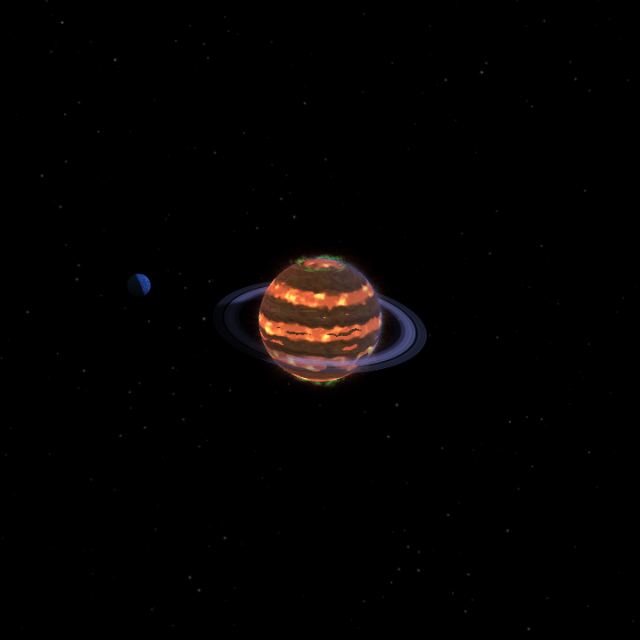
Nemesis VII
Brown Dwarf
- Mass
- 4671.00 × Earth
- Radius
- 16.72 × Earth
- Gravity
- 16.72 g
- Surface
- 454 K
- Year
- 393,121 years
- Day
- 5.0 hrs
- Mass
- 4671.00 × Earth
- Radius
- 16.72 × Earth
- Gravity
- 16.72 g
- Surface
- 454 K
- Year
- 393,121 years
- Day
- 5.0 hrs
Nemesis VII's star
O-type · Blue Supergiant
Nemesis VII16674.70 AUBrown DwarfYou are hereHabitable zone
Star and planet drawn to scale (a typical star of its class), with only the star's edge in view. Orbits spaced as in the star system view.
Nemesis VII's moons
1 moon
Moon 3Ocean · 1,906,300 km
Planet, moons and orbits drawn to one scale; the smallest moons are enlarged so they can be seen.
Surface. No surface: the coldest class of failed star, barely warmer than a summer day and glowing only in the infrared
Brown Dwarf
Magnetic FieldNone Activity
Barren worlds can form from uncommon element combinations or may be remnants of larger bodies that lost their atmospheres and volatile materials.
Classification Criteria:
Composition doesn't match standard planet typesMass: 4671.0x EarthTemperature: 454K
Habitability ScoreUninhabitable
Contributing Factors
water15
No solid surface — any water is locked in a supercritical mantle and hot ice, not oceans
geology30
Geologically dead - no nutrient recycling
rotation10
Near tidally locked - one hemisphere perpetually scorched, other frozen, narrow habitable twilight zone only
Organic Chemistry80
Core organic elements (CHNO) present
atmosphere12
Cold hydrogen and helium with ammonia and water clouds
Hydrogen-rich atmosphere typical of gas giants (partially stripped by slow rotation)temperature20
Extremely hot - hostile to known life forms (large moon stabilizes the axial tilt - steady seasons)
magnetic Field25
A strong field, but no surface beneath it — there is nothing here for it to shelter (a large close moon may help stir the core dynamo (speculative))
Physical Properties
Mass
4671.00x Earth (2.79e+28 kg)Radius
16.72x Earth (106,499 km)Surface Gravity
16.72x Earth (164.0 m/s²)Surface Temperature
454 K (181 °C / 357 °F)Rotation Period
5.0 hours/day (faster than Earth)Elemental Composition
Closest Real Exoplanet
WD 0806-661 b59% similar
Orbiting WD 0806-661| Yours | WD 0806-661 b | |
|---|---|---|
| Mass | 4,671 × Earth | 2,220 × Earth |
| Radius | 16.7 × Earth | 12.1 × Earth |
| Density (composition) | — | 6.90 g/cm³ |
| Temperature | 453.9 K | 357.0 K |
| Starlight received | 0.00 × Earth | — |
| Star temperature | 35,000 K | 10,393 K |
Moons
Moon 1merged
Merged with an adjacent moon: too close for both to hold a stable orbit.
Moon 2rings
Inside the Roche limit (1.79 planet radii): torn apart into a ring system.
Moon 3recedingOcean world
Outside the synchronous orbit: slowly receding, like Luna (~cm per year).
Tidal braking locked the planet to its moon: one face forever moonward.
A thin tidal-warmed subsurface ocean may exist, but conditions are marginal (30/100).
+5 temperature: large moon stabilizes the axial tilt - steady seasons+5 magneticField: a large close moon may help stir the core dynamo (speculative)