Entering orbit…
AI assistant
Habitability
15/ 100
View planet
View star system
View surface
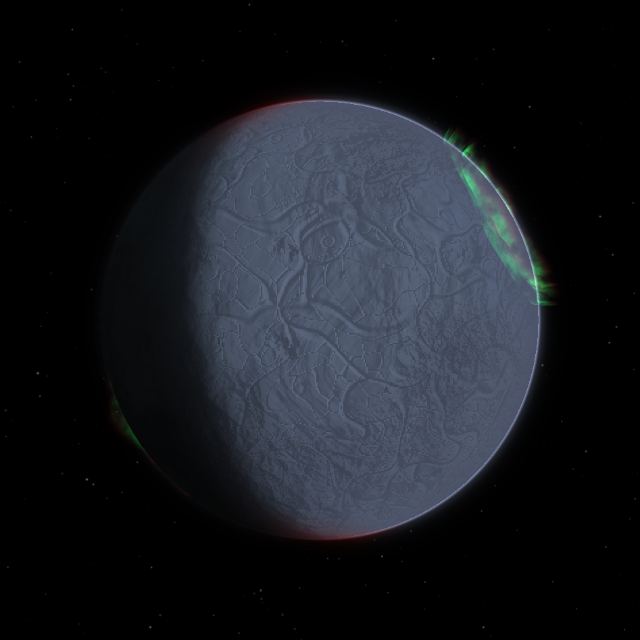
O'Harraigh
0
Barren
✦ OloumNo life — too cold for liquid waterMagnetic FieldHigh Activity
Why is this a Barren?Your planet has an unusual composition that doesn't fit standard classifications, or lacks the elements needed for complex geological processes.
Barren worlds can form from uncommon element combinations or may be remnants of larger bodies that lost their atmospheres and volatile materials.
Classification Criteria:
Composition doesn't match standard planet typesMass: 2.1x EarthTemperature: 83K
Habitability ScoreUninhabitable
Contributing Factors
water20
Good water content - frozen solid, no liquid phase at this temperature
geology90
Active geology recycles nutrients and drives carbon cycle
rotation25
Very fast rotation - perpetual hurricane-force winds, extreme Coriolis effects, hazardous for complex life
Organic Chemistry100
All CHNOPS elements present - building blocks of life
atmosphere50
CO₂ atmosphere with moderate greenhouse effect
temperature10
Frozen world - minimal potential for complex life (extreme seasons: at 58° the poles swing between months-long day and night: −7% habitability)
magnetic Field100
Magnetic field provides radiation protection
Physical Properties
Mass
2.10x Earth (1.25e+25 kg)Radius
1.28x Earth (8,159 km)Surface Gravity
1.28x Earth (12.6 m/s²)Surface Temperature
83 K (-190 °C / -310 °F)Rotation Period
6.0 hours/day (faster than Earth)Orbital Environment
Star Type
NS-type (Neutron Star)Distance from Star
2.43 AU (364 million km)Orbital Period
3.20 yearsAtmosphere
Thin CO₂ atmosphere
Elemental Composition
H - Hydrogen
34.0%
Ar - Argon
20.6%
C - Carbon
14.4%
Surface Characteristics
Barren rocky surface with unusual elemental compositionClosest Real Exoplanet
HD 95735 c45% similar
Orbiting GJ 411| Yours | HD 95735 c | |
|---|---|---|
| Mass | 2.10 × Earth | 13.6 × Earth |
| Radius | 1.24 × Earth | 3.76 × Earth |
| Density (composition) | 6.10 g/cm³ | 1.41 g/cm³ |
| Temperature | 83.4 K | 63.0 K |
| Starlight received | 0.00 × Earth | 0.00 × Earth |
| Star temperature | — | 3,719 K |