Entering orbit…
AI assistant
Habitability
0/ 100
View planet
View star system
View surface
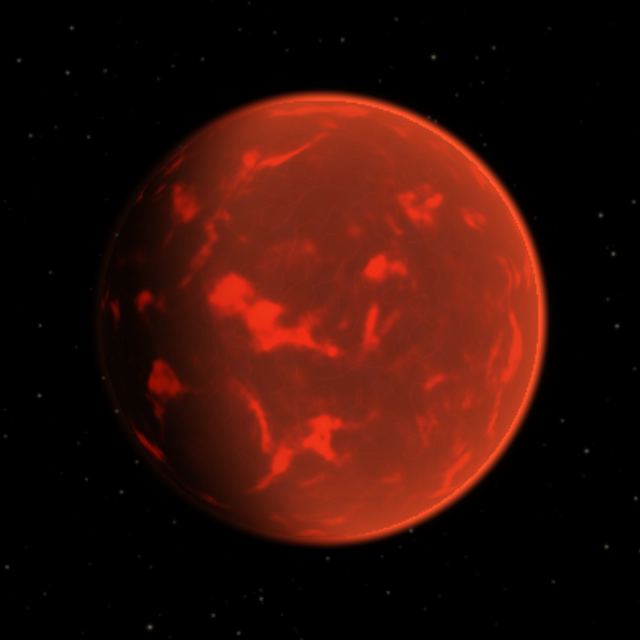
JHO836362Y
0
Lava World
Magnetic FieldExtreme Activity
Why is this a Lava World?A moon inside the synchronous orbit spiraled in and struck the planet. The impact remelted the surface into a global magma ocean.
Tidal decay drags close-in moons down over millions of years. A large enough impactor liquefies the crust, strips atmosphere, and resets the surface - whatever the orbit's temperature would otherwise allow.
Classification Criteria:
✓ Moon inside the synchronous orbit (tidal decay)✓ Impactor massive enough to remelt the crust- Orbit itself was fine: 310.00 AU, 1400K equilibrium
Habitability ScoreUninhabitable
Contributing Factors
water15
Abundant water - boiling away, little would be retained
geology50
Extreme volcanic activity may be hazardous (impact-resurfaced crust)
rotation60
Fast rotation - strong global wind patterns and weather systems, but manageable
Organic Chemistry80
Core organic elements (CHNO) present
atmosphere4
Atmosphere present but composition not ideal for life (atmosphere partially stripped by the moon impact)
temperature0
Inferno world - temperatures exceed all possibility of life
magnetic Field100
Magnetic field provides radiation protection
Physical Properties
Mass
1.00x Earth (5.97e+24 kg)Radius
1.00x Earth (6,371 km)Surface Gravity
1.00x Earth (9.8 m/s²)Surface Temperature
1,400 K (1,127 °C / 2,060 °F)Rotation Period
12.0 hours/day (faster than Earth)Orbital Environment
Star Type
O-type (Blue Supergiant)Distance from Star
310.00 AU (46.4 billion km)Orbital Period
996.5 yearsAtmosphere
Vaporized rock and impact ash - the original atmosphere blown off by the strike
Elemental Composition
N - Nitrogen
23.7%
H - Hydrogen
21.1%
O - Oxygen
13.2%
Surface Characteristics
Surface remelted by a catastrophic moon impact - a global magma ocean cooling into scarred rockClosest Real Exoplanet
Kepler-1512 b53% similar
Orbiting Kepler-1512| Yours | Kepler-1512 b | |
|---|---|---|
| Mass | 1.00 × Earth | 1.76 × Earth |
| Radius | 1.00 × Earth | 1.18 × Earth |
| Density (composition) | 5.50 g/cm³ | 5.90 g/cm³ |
| Temperature | 1,400 K | 322.0 K |
| Starlight received | 1.04 × Earth | 1.60 × Earth |
| Star temperature | 35,000 K | 4,372 K |
Moons
Moon 1crashed10% - 3.2 radii
Inside the synchronous orbit: tidal decay dragged it down - it struck the planet ages ago.