Entering orbit…
AI assistant
Habitability
0/ 100
View planet
View star system
View surface
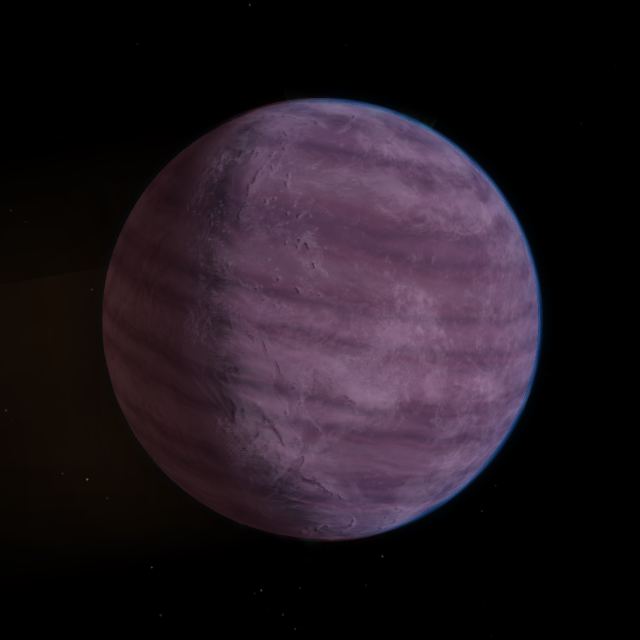
purp
0
Gas Giant
✦ Blu systemMagnetic FieldExtreme Activity
Why is this a Gas Giant?Your planet has 65.0% hydrogen and helium, combined with a mass of 19.0x Earth, which exceeds the gas giant threshold.
Gas giants form when massive cores capture enormous atmospheres of light gases. They typically form beyond the 'frost line' where volatiles can condense.
Classification Criteria:
✓ Hydrogen + Helium: 65.0% (>60% required)✓ Mass: 19.0x Earth (>10x required)
Habitability ScoreUninhabitable
Contributing Factors
water15
No solid surface — any water is locked in a supercritical mantle and hot ice, not oceans
geology40
Extreme volcanic activity may be hazardous
rotation10
Near tidally locked - one hemisphere perpetually scorched, other frozen, narrow habitable twilight zone only
Organic Chemistry80
Core organic elements (CHNO) present
atmosphere12
Hydrogen-rich atmosphere typical of gas giants (partially stripped by slow rotation)
temperature0
Inferno world - temperatures exceed all possibility of life
magnetic Field100
Magnetic field provides radiation protection
Physical Properties
Mass
19.00x Earth (1.13e+26 kg)Radius
2.67x Earth (17,000 km)Surface Gravity
2.67x Earth (26.2 m/s²)Surface Temperature
1,314 K (1,041 °C / 1,906 °F)Rotation Period
2,000.0 hours/day (slower than Earth)Orbital Environment
Star Type
B-type (Blue Giant)Distance from Star
6.58 AU (984 million km)Orbital Period
5.34 yearsAtmosphere
Hydrogen and helium dominated with trace methane and ammonia
Elemental Composition
H - Hydrogen
45.0%
He - Helium
20.0%
O - Oxygen
15.0%
Surface Characteristics
No solid surface - thick gaseous envelope with possible rocky core deep withinClosest Real Exoplanet
Kepler-959 b77% similar
Orbiting Kepler-959| Yours | Kepler-959 b | |
|---|---|---|
| Mass | 19.0 × Earth | 17.6 × Earth |
| Radius | 4.32 × Earth | 4.38 × Earth |
| Density (composition) | 1.30 g/cm³ | 1.15 g/cm³ |
| Temperature | 1,314 K | 1,912 K |
| Starlight received | 231.0 × Earth | 166.0 × Earth |
| Star temperature | 20,000 K | 7,005 K |