Entering orbit…
AI assistant
Habitability
95/ 100
View planet
View star system
View surface
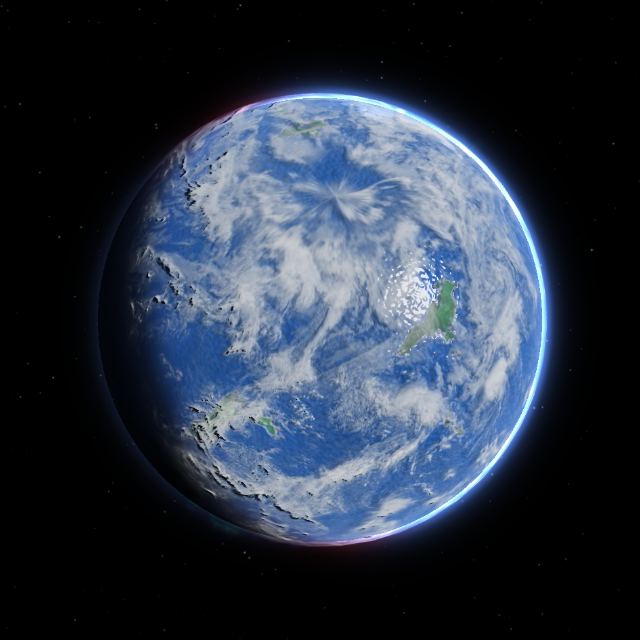
rafarna
0
is home of civilization rafarnians is a one of four advanced civilizations on cafarna system and had two big moons one is like moons and also is on near venus like world soon around 1-2 billion years from now and also had so many satellites for daily life because is advanced
Earth Like
✦ cafarnaLife possibleMagnetic FieldModerate Activity
Why is this a Earth Like?
Your planet has a balanced composition with all CHNOPS elements, proper mass (1.3x Earth), and sits in the habitable zone at 0.91 AU.Earth-like planets have the perfect combination of composition, temperature, mass, and magnetic field to potentially support complex life as we know it.
Classification Criteria:
✓ All CHNOPS elements present (C, H, N, O, P, S)✓ Mass: 1.3x Earth (0.5-2.0x range)✓ Temperature: 292K (250-320K range)✓ Magnetic field present✓ Distance: 0.91 AU (habitable zone)
Habitability ScoreHighly Habitable
Contributing Factors
water100
Abundant water
geology90
Active geology recycles nutrients and drives carbon cycle
rotation100
Optimal rotation period - balanced day/night cycle, moderate weather, and good heat distribution
Organic Chemistry84
Core organic elements (CHNO) present (tidal pools cycle wet and dry - a boost for prebiotic chemistry)
atmosphere100
Nitrogen-oxygen atmosphere - breathable and protective
temperature100
Optimal temperature range for liquid water and life
magnetic Field100
Magnetic field provides radiation protection
Physical Properties
Mass
1.30x Earth (7.76e+24 kg)Radius
1.09x Earth (6,953 km)Surface Gravity
1.09x Earth (10.7 m/s²)Surface Temperature
292 K (19 °C / 66 °F)Rotation Period
21.0 hours/day (faster than Earth)Orbital Environment
Star Type
G-type (Yellow (Sun-like))Distance from Star
0.91 AU (136 million km)Orbital Period
317 daysAtmosphere
Nitrogen-oxygen atmosphere with trace CO₂, water vapor, and argon
Elemental Composition
O - Oxygen
24.2%
N - Nitrogen
19.3%
Si - Silicon
19.3%
Surface Characteristics
Rocky surface with continents, oceans, and active plate tectonics. Diverse biomes if life present.Closest Real Exoplanet
Kepler-438 b91% similar
Orbiting Kepler-438| Yours | Kepler-438 b | |
|---|---|---|
| Mass | 1.30 × Earth | 1.46 × Earth |
| Radius | 1.07 × Earth | 1.12 × Earth |
| Density (composition) | 5.78 g/cm³ | 5.73 g/cm³ |
| Temperature | 291.9 K | 288.0 K |
| Starlight received | 1.21 × Earth | 1.40 × Earth |
| Star temperature | 5,600 K | 3,748 K |
Moons
Moon 1receding1.1% - 63.4 radii
Outside the synchronous orbit: slowly receding, like Luna (~cm per year).
Moon 2receding0.050% - 31.4 radii
Outside the synchronous orbit: slowly receding, like Luna (~cm per year).
Habitability
✓ Conditions could support lifeThis planet’s modelled conditions could support biological processes: stable temperatures, liquid water and the chemistry life as we know it needs. That makes life possible, not present.Love TerraForge? Please help support us.Keeps it ad-free, and funds new features and hosting.