Entering orbit…
AI assistant
Habitability
71/ 100
View planet
View star system
View surface
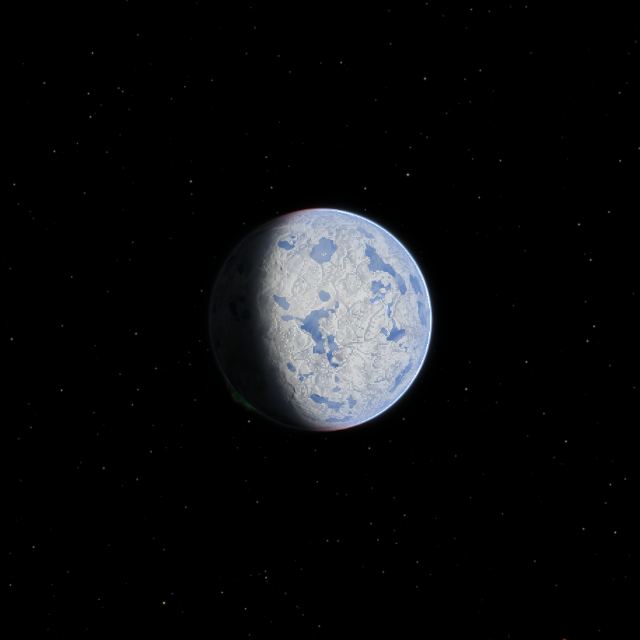
Mn-hniK
- Mass
- 2.80 × Earth
- Radius
- 1.41 × Earth
- Gravity
- 1.41 g
- Surface
- 348 K
- Year
- 371 days
- Day
- 45.0 hrs
- Mass
- 2.80 × Earth
- Radius
- 1.41 × Earth
- Gravity
- 1.41 g
- Surface
- 348 K
- Year
- 371 days
- Day
- 45.0 hrs
 Mn-hniK1.01 AUExotic TerrestrialYou are here
Habitable zone
Star and planets drawn to scale (a typical star of its class), with only the star's edge in view. Orbits spaced as in the star system view.
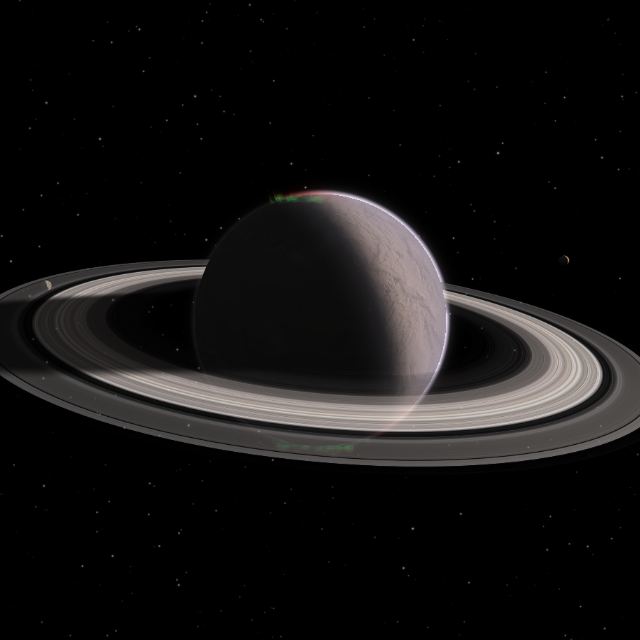
Mn-hniK's moons
2 moons
Moon 1Ice · 201,400 km
Moon 2Iron · 95,800 km
Planet, moons and orbits drawn to one scale; the smallest moons are enlarged so they can be seen.
Within Kcrrut's habitable zone, Mn-hniK is able to host life. That is, if you can survive its vast salt flats.
With a slow rotation and notable tilt, the temperature here is harsh. But could be considered worth it if you want to stargaze with two moons and constant meteor showers
Surface. Pale mineral plains — carbonate flats, chalk mesas, and crusts no silicate world can build
✓ Conditions could support life. This planet’s modelled conditions could support biological processes: stable temperatures, liquid water and the chemistry life as we know it needs. That makes life possible, not present.
Exotic Terrestrial
✦ Kcrrut
Your planet builds its crust from exotic minerals (14.5% calcium/titanium/aluminum-family rock formers) instead of the silicate-iron recipe every standard rocky world uses.Life possibleMagnetic FieldHigh Activity
Exotic terrestrials are temperate solid worlds whose geology skipped the silicate playbook - carbonate plains, titanium-gray mesas, alkali flats. They can hold air, water ingredients, and real habitability, but with no silicate continents or iron core they are their own class, not earth-likes.
Classification Criteria:
✓ Exotic rock formers: 14.5% (>=12% Ca/Ti/Al/K/Ni/U)✓ Standard rock: 4.8% (<15% - silicate rules never claimed it)✓ Temperature: 348K (240-380K temperate band)✓ Air + water ingredients: 30.6% O+H (>=15%) with an atmosphere
Habitability ScoreHabitable
Contributing Factors
water90
Good water content
geology90
Active geology recycles nutrients and drives carbon cycle
rotation65
Slow rotation - significant day/night temperature variations, but life can adapt
Organic Chemistry54
Carbon and hydrogen present - organic chemistry possible (tidal pools cycle wet and dry - a boost for prebiotic chemistry)
atmosphere50
Thin CO₂ atmosphere
CO₂ atmosphere with moderate greenhouse effecttemperature70
Challenging but potentially habitable temperature (strong seasons from a 46° tilt, softened by deep oceans: −1% habitability)
magnetic Field100
Magnetic field provides radiation protection
Physical Properties
Mass
2.80x Earth (1.67e+25 kg)Radius
1.41x Earth (8,980 km)Surface Gravity
1.41x Earth (13.8 m/s²)Surface Temperature
348 K (75 °C / 167 °F)Rotation Period
45.0 hours/day (slower than Earth)Elemental Composition
Closest Real Exoplanet
L 98-59 f88% similar
Orbiting L 98-59| Yours | L 98-59 f | |
|---|---|---|
| Mass | 2.80 × Earth | 2.80 × Earth |
| Radius | 1.40 × Earth | 1.48 × Earth |
| Density (composition) | 5.59 g/cm³ | 4.76 g/cm³ |
| Temperature | 348.4 K | 285.0 K |
| Starlight received | 0.98 × Earth | 1.10 × Earth |
| Star temperature | 5,600 K | 3,415 K |
Moons
Moon 1stable
Small and distant: a quiet, stable companion.
Moon 2stableIron-rich rock
Small and distant: a quiet, stable companion.
+4 chemistry: tidal pools cycle wet and dry - a boost for prebiotic chemistry