Entering orbit…
AI assistant
Habitabilityno longer habitable
View planet
View star system
View surface
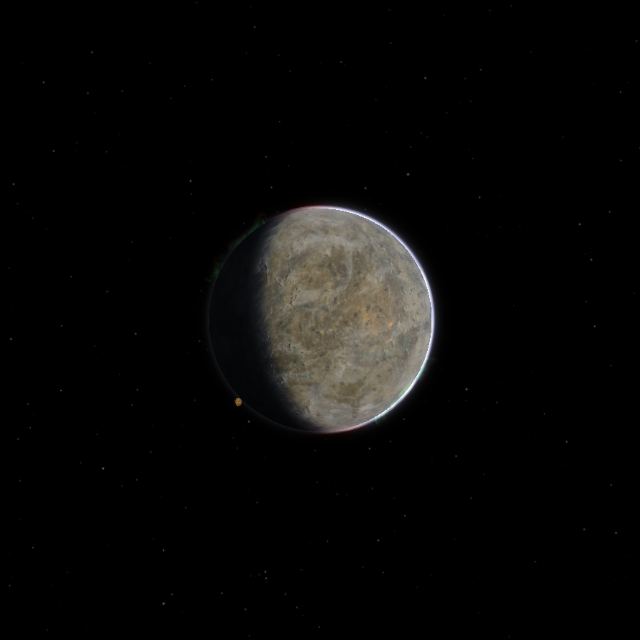
Sacer Filius 2
0
Ice World
✦ Amor ParentisDestroyed — no longer habitableMagnetic FieldLow Activity
Why is this a Ice World?Your planet orbits at 1.88 AU from its star, resulting in frigid temperatures of 98K.
Ice worlds form beyond the frost line where temperatures are low enough for water and other volatiles to freeze solid. They may have subsurface oceans beneath thick ice shells.
Classification Criteria:
✓ Distance: 1.88 AU (>3 AU) or Temperature <200K✓ Temperature: 98K✓ Water content: 50.0% for ice formation
Habitability
Destroyed — no longer habitablePhysical Properties
Mass
1.70x Earth (1.02e+25 kg)Radius
1.19x Earth (7,604 km)Surface Gravity
1.19x Earth (11.7 m/s²)Surface Temperature
98 K (-176 °C / -284 °F)Rotation Period
19.0 hours/day (faster than Earth)Orbital Environment
Star Type
M-type (Red Dwarf)Distance from Star
1.88 AU (281 million km)Orbital Period
4.71 yearsAtmosphere
Thin nitrogen and methane atmosphere
Elemental Composition
O - Oxygen
41.2%
H - Hydrogen
17.6%
N - Nitrogen
11.8%
Surface Characteristics
Frozen surface covered in water ice, possible subsurface ocean if tidal heating presentClosest Real Exoplanet
GJ 1151 c55% similar
Orbiting GJ 1151| Yours | GJ 1151 c | |
|---|---|---|
| Mass | 1.70 × Earth | 10.6 × Earth |
| Radius | 1.46 × Earth | 3.25 × Earth |
| Density (composition) | 3.00 g/cm³ | 1.70 g/cm³ |
| Temperature | 97.6 K | 88.0 K |
| Starlight received | 0.01 × Earth | 0.01 × Earth |
| Star temperature | 3,050 K | 3,280 K |