Entering orbit…
AI assistant
Habitability
0/ 100
View planet
View star system
View surface
denus
0
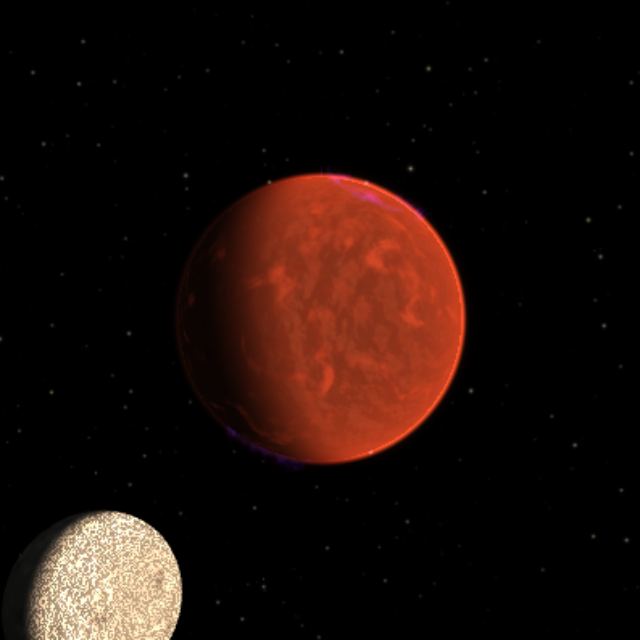
Volcanic World
✦ josystemMagnetic FieldExtreme Activity
Why is this a Volcanic World?Runaway tidal heating from its moons drives volcanism across a cold crust - the planet is kneaded like Io.
Resonant, close-in moons pump orbital eccentricity, and the resulting tidal flexing dissipates enormous heat in the interior. Only a fraction of the surface is molten at once, so the ground between the vents stays as cold as the orbit allows - Io's own equilibrium temperature is about 110 K.
Classification Criteria:
✓ Close-in moons in a resonant configuration✓ Tidal heat flux beyond the runaway threshold- The orbit is not what melted it: 0.10 AU, 953K equilibrium
Habitability ScoreUninhabitable
Contributing Factors
water0
No water - the recipe has no hydrogen and oxygen to form it
geology40
Extreme volcanic activity may be hazardous
rotation10
Near tidally locked - one hemisphere perpetually scorched, other frozen, narrow habitable twilight zone only
Organic Chemistry50
Carbon and hydrogen present - organic chemistry possible
atmosphere16
Atmosphere present but composition not ideal for life (partially stripped by slow rotation)
temperature0
Scorching - hot enough to melt lead, though rock stays solid; no chance for life (large moon stabilizes the axial tilt - steady seasons) (runaway tidal heating keeps the surface molten regardless of orbit)
magnetic Field100
Magnetic field provides radiation protection (a large close moon may help stir the core dynamo (speculative))
Physical Properties
Mass
1.80x Earth (1.07e+25 kg)Radius
1.22x Earth (7,750 km)Surface Gravity
1.22x Earth (11.9 m/s²)Surface Temperature
953 K (680 °C / 1,256 °F)Rotation Period
20.0 hours/day (faster than Earth)Orbital Environment
Star Type
G-type (Yellow (Sun-like))Distance from Star
0.10 AU (15 million km)Orbital Period
12 daysAtmosphere
Volcanic outgassing - sulfur compounds and vaporized rock
Elemental Composition
C - Carbon
40.5%
Fe - Iron
16.2%
Si - Silicon
13.5%
Surface Characteristics
Runaway tidal heating drives volcanism across a cold crust - lava lakes and sulfur plains between frozen plainsClosest Real Exoplanet
Kepler-495 c96% similar
Orbiting Kepler-495| Yours | Kepler-495 c | |
|---|---|---|
| Mass | 1.80 × Earth | 1.98 × Earth |
| Radius | 1.18 × Earth | 1.22 × Earth |
| Density (composition) | 6.04 g/cm³ | 6.01 g/cm³ |
| Temperature | 953.4 K | 1,000 K |
| Starlight received | 100.0 × Earth | 108.0 × Earth |
| Star temperature | 5,600 K | 5,392 K |
Moons
Moon 1receding10% - 7.5 radii
Outside the synchronous orbit: slowly receding, like Luna (~cm per year).
Tidal braking locked the planet to its moon: one face forever moonward.